Adversarial Patterns for Designers: When Fabric Defeats a Vision Model
Berlin is rolling out AI behavior-scanning cameras, and a German artist is selling a shirt whose pattern makes YOLO object detectors stop seeing the wearer. The computer vision principles behind adversarial patterns matter to anyone who makes images with AI, because detectors and generators can both reflect learned visual patterns, even though their objectives and failure modes differ.
AI-assisted draft. Reviewed and edited by the Phosphene team before publication.
On this page
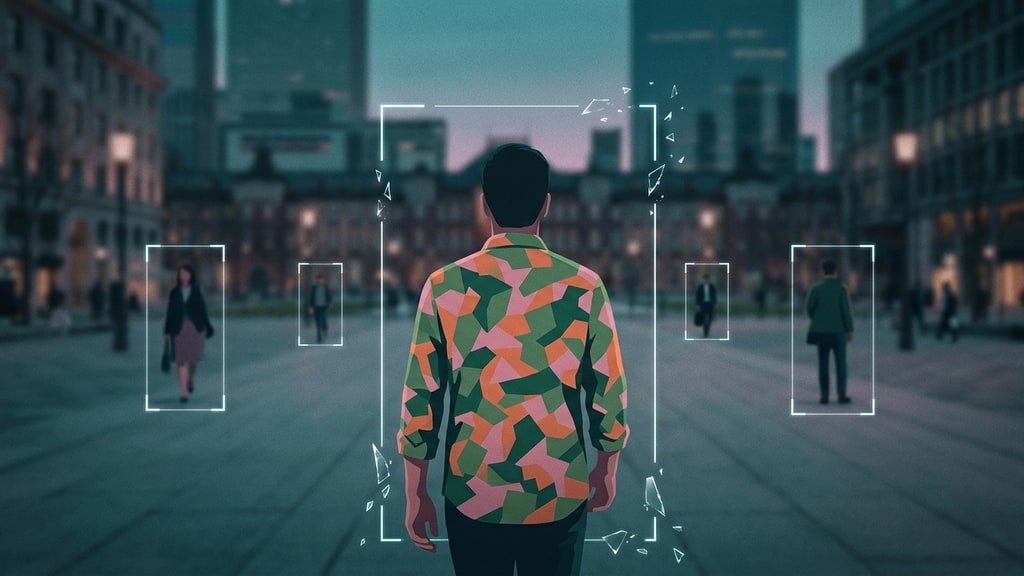
German artist Simon Weckert, the man who once walked Berlin's streets pulling a wagon loaded with 99 phones to fake a traffic jam on Google Maps, has a new piece of adversarial clothing. Berlin has started switching on AI-assisted surveillance cameras at Kottbusser Tor. Weckert's response is the Digital Camouflage Shirt, a garment with an abstract pattern of green, pink, and orange shapes that reads like pop art to a human and like static to a person-detector. It sells for 91 dollars.
The shirt works against YOLO, the open-source object-detection family that sits inside a large share of commercial video analytics systems. In the project's on-site demonstrations, the detector labels every passer-by as "person" except the wearer. Present to every human eye, absent to the model.
That inversion is worth a closer look, because the statistical pattern-matching behind it is a cousin of the machinery that decides whether your generated images look right.
Detectors do not see, they match statistical patterns
The seductive intuition is that a vision model sees the way we do, and that fooling it means visual trickery: camouflage in the military sense, blending into the background. The reality is stranger and more useful to understand.
An object detector never looks at your shirt and asks "what is that." It slides across the image hunting for the statistical signatures of edges, textures, and color arrangements that its training data associated with the category "person." If the input fails to produce those signatures, the category never fires. The shirt does not hide the wearer. It breaks the match.
A helpful analogy from how these systems are trained: the detector is built from annotated detection examples — millions of images with person labels and bounding boxes. Corrupt enough of those features and the concept stops activating. Human eyes, which parse shape and context holistically, are untouched.
The same is true in reverse for generation. Text-to-image models do not understand "silk" or "crowd." They reproduce the texture statistics their training material attached to those words. This is why prompt keywords map to visual textures so reliably, and why mismatched texture statistics are exactly what makes a composite look pasted together: you are addressing the statistics directly.
The transfer problem, or why lab evasion dies on the street
The pattern was not hand-drawn. It was computationally generated, an optimization problem: distort the input just enough that the detector's confidence in "person" drops below its threshold.
Here is the catch. Adversarial patterns are typically optimized against a specific model. A pattern tuned to one YOLO version can fade against another detector, a retrained model, or different capture conditions. The project page says exactly this: results depend on the specific model, distance, angle, and lighting. Weckert himself makes no guarantee against every AI camera, and nobody outside the authorities can test what Berlin's system actually runs.
This is the transfer problem in adversarial ML, and it is the reason a piece of fabric can undo a widely used open-source detector while remaining an art project rather than an invisibility cloak.
Why a designer should care
If you make images with generative AI, you are operating related machinery from the other side — a different objective (denoising, not detection) learning from similar statistical soil. Three practical takeaways.
Texture is meaning. When a detector misreads your image, or a generator mangles a request, the failure often lives in texture statistics rather than composition — though it can also involve composition, geometry, context, or conditioning. A model asked for "denim" delivers the statistical fingerprint of denim from its training set. When you want a specific visual effect, name the texture, not just the object.
The texture frontier is bidirectional. Researchers fool detectors with patterned textiles, and detectors get retrained to catch those patterns, a cycle that has been running in papers for years. Generators live the same arms race: as soon as a visual trick becomes common, the next model version has seen a million examples of it and the trick stops working. Prompting techniques expire for the same reason adversarial patterns do.
And visually loud patterns are load-bearing. The hardest design constraint Weckert faced was not technical but aesthetic: pure adversarial patterns are effective and hideous, so he used AI to search for a middle ground, a pattern that both breaks the detector and looks acceptable to a human. That trade-off between machine efficacy and human perception is the same one every generative workflow negotiates when it asks whether an image is for an algorithm or for an audience.
What to do on Monday
- When an image model keeps misreading your request, change the texture words before touching composition.
- Re-test your go-to prompt tricks whenever a model version changes. They may have silently expired.
- If a workflow depends on one model's quirks, date-stamp that dependency. It is perishable, exactly like an adversarial pattern tuned to one detector.
The Berlin shirt is a stunt with a research pedigree: its pattern was trained with an open-source adversarial texture system, on top of published work on physical-world evasion. As a product it is not infallible. As a demonstration that machine perception is a different sense than ours, and one you can learn to address deliberately, it is worth more than the fabric it is printed on.