Why AI Posters Make People Angry
French streets filled up with AI-generated flyers this summer and the backlash went viral: one drawing pulled 1.2 million views in three days. A look at what the anger is actually about, and how to make cheap visuals that do not read as slop.
AI-assisted draft. Reviewed and edited by the Phosphene team before publication.
On this page
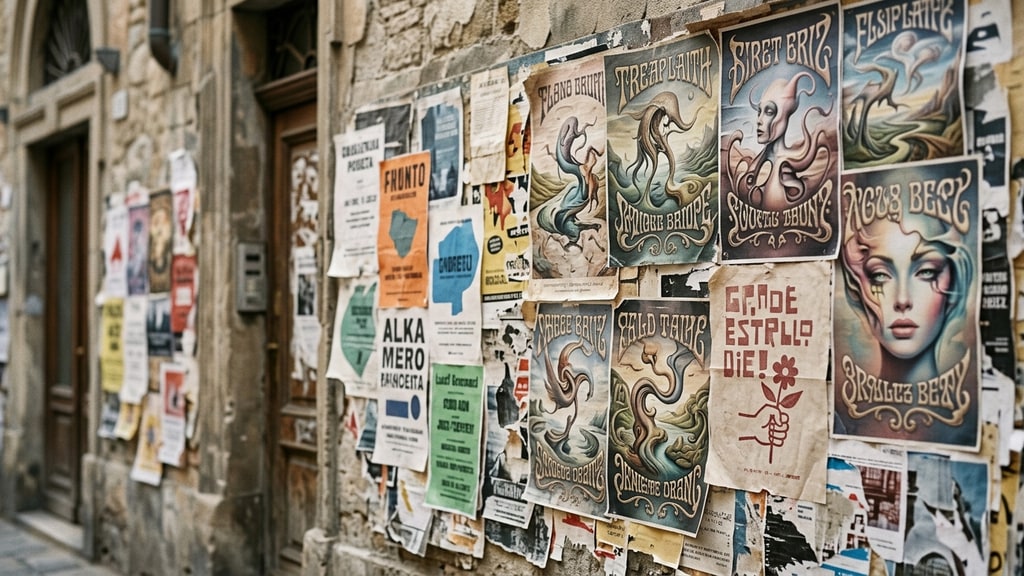
This summer the cheap poster won. School fair programs, restaurant menus, concert announcements, flea-market flyers: across France a remarkable share of the paper going up on walls and shop windows was generated by an AI image model. The tools got cheap and easy, so town associations and small businesses did the obvious thing and stopped paying designers.
Then the audience answered. An illustrator from Metz who publishes as Léa Pixels came back from a van trip on the Atlantic coast with what she describes as sore eyes: posters everywhere, in the streets, in the shops, all visibly machine-made. Her response was a drawing. It riffs on a couple who unfurled a banner on top of the Empire State Building earlier this summer, except in her version the couple proclaims they will not come to your event if the poster was made with AI. In three days the post gathered 1.2 million views and about 90,000 likes on Instagram. She told Le Monde she is now overwhelmed by the anger arriving in her comments, from a debate that has grown bigger than her.
That anger is the interesting part, because it is not really about AI.
What the audience is reacting to
Strip the ideology out and look at the artifacts. The typical AI event poster has a short list of tells. Everything is rendered in the same glossy, over-lit style, whether the event is a punk concert or a parish bake sale. The composition is a pile of loosely related objects floating in soft focus. Any text is almost right: correct-looking words with spacing that no typesetter would produce, or a word that dissolves into ornamental shapes. Hands hold things at angles that survive a half-second glance and fall apart under a second one.
None of these flaws is fatal alone. What makes them combustible is the context. A poster is a request for your time and often your money, pinned up in a shared space by an institution with a name on it. When that request arrives visibly machine-generated, the message the audience actually receives is: nobody here spent a minute on this. The illustrator's own line is blunter. She has been printing variations of "bad art is better than AI" for a while, and the sentiment underneath is that a clumsy human flyer still contains evidence of a person who tried.
There is a second, quieter signal in her work: people want to see the real thing. Her complaint about AI product images is that buyers want the actual product, not a rendered fantasy of it. The same applies to a flyer. A blurry phone photo of last year's fair, cropped square with the date set in one loud typeface, outperforms a flawless AI collage of a fair that never happened, because the photo is evidence.
The backlash is selective, which proves the point. The same audiences share AI memes and AI music videos all day. Where they push back is the combination of public space, a money ask, and zero visible effort. Trust is the currency being spent, and slop posters are a default on it.
Rouen showed the exit
The pressure is already producing institutional change. In July, Rouen became what the regional press called the first French city to give up AI for its event posters, after a collective of authors challenged the machine-made artwork for the city's "Rouen Givrée" winter campaign. The city did not renounce AI as a matter of doctrine; it responded to the argument that publicly funded visuals should not erase the people who make them.
That distinction matters for anyone reading this as another chapter of the AI culture war. It is more practical than that. A city, a school, a restaurant that posts an AI flyer is making a claim about how much the event matters. The audience has simply started auditing the claim.
The pattern is not French either. In Bozeman, Montana, a Christmas poster put a community committee through weeks of controversy over whether AI had been used and how much. Local noise, but the same mechanism: an institution's visual choices got read as a statement of care, and the statement was contested.
How to make cheap visuals that survive contact with the public
Most of the organizations reaching for AI posters are not villains; they are broke. The honest answer is that cheap and respectable is a solved problem, and none of the working solutions require a diffusion model in the final step.
- Go typographic. The strongest budget flyer in history is still big type on colored paper: event name, date, place, one accent color. Type carries personality for free, and models still cannot set it reliably, so keeping text out of the generation pass removes the tell that triggers the most ridicule.
- Photograph the real thing. One decent photo of the actual venue, the actual band, the actual dish, with the date stamped over it, does more convincing than any generated scene. Evidence beats polish.
- Use flat illustration, or none. A single-color spot illustration, even a clumsy one, reads as intentional. A generated illustration with fifteen light sources reads as a slot machine payout.
- If you do use AI in the pipeline, keep it where the audience cannot audit it: moodboards, background textures, rough ideation for layouts you will redraw. The moment the artifact itself is the unedited output, you have published the fact that you did not check.
What this means if you make images with AI for a living
For people whose whole workflow is generative, the summer of poster rage carries a specific warning: slop is a tax on the medium. Every glossy, text-mangled flyer pinned to a café wall trains another thousand passersby to flinch at anything that smells generated. The medium's reputation is a shared resource, and it is currently being strip-mined by people who never read a single prompt twice.
The professionals who publish generated imagery and keep their audience do the same few things. They keep typography out of the diffusion pass and set it afterward. They keep a reference anchored, so the character in shot forty is still the character from shot two. And they ship a human pass on everything that faces the public, not as a formality but as the actual product. The generation is the draft; the judgment is the deliverable.
That is also, for what it is worth, the whole bet behind template-first generation as we build it at Phosphene. One giant free-form prompt is exactly how those posters happen: all the choices delegated at once, none of them checked. A template forces the choices that matter, references, style, composition, into visible slots a person actually reviews before spending a credit. The point is not that AI imagery is fine when a human clicks the button. It is that care has to be legible in the result.
The honest version of the slogan
"Bad art is better than AI" is unfair to good AI work, but it is a precise description of what the audience is auditing for. Bad human art carries proof of effort. Machine output with no edit carries proof of its absence, printed at A3 and taped to a door with a price on it.
The crowd is not asking businesses to hire illustrators for every bake sale. It is asking for a signal that a person was there. Give it one, and nobody checks whether the background texture came from a model. Skip it, and no amount of rendering quality will save the flyer, because what is being read is not the image. It is the intent.
Sources
- Face au déferlement des affiches utilisant l’IA dans l’espace public, la résistance en ligne s’organise (French original, Le Monde)
- Une première en France : la Ville de Rouen renonce à l’IA pour ses affiches (Paris-Normandie)
- Winning Christmas Poster Pulled Over Artificial Intelligence Accusations In Bozeman (Cowboy State Daily)