The Looking Glass: When a Map, a Year, and a Prompt Become a Time Machine
A French tech publication covered an open-source tool that generates an image of any point on Earth at any year from the Permian extinction to 3050. It is not an archive. It is a three-model pipeline bolted onto a map, and studying its architecture teaches a more useful lesson than the postcards: the strongest generative products are structured compositions of ordinary models, not frontier weights.
AI-assisted draft. Reviewed and edited by the Phosphene team before publication.
On this page
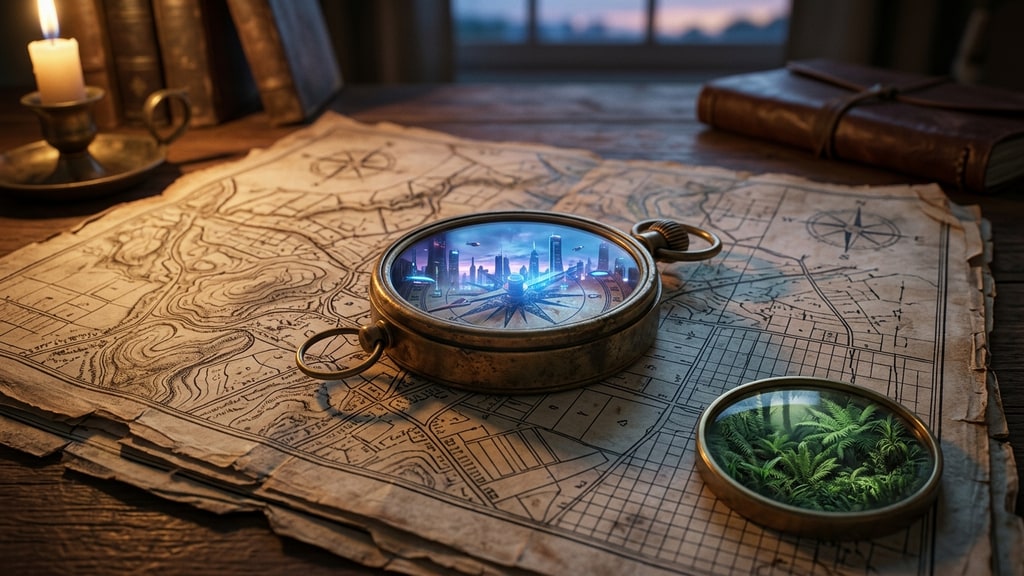
Pick a point on a map, any point. Your childhood street, the empty lot across from your office, the middle of the Colosseum. Pick a year: 1600, 1944, five million years ago, 3050. Pull a lever, and a few seconds later you are looking at a rendered image of that place at that time. Maybe.
That is The Looking Glass, presented on July 31, 2026 by its developer, known on X as @Elder_plinius, and covered in detail by the French tech publication Numerama. You can point it at your own neighborhood a few centuries back or fast-forward a millennium, and if the mood strikes, animate the result into a short video with sound. It spreads the way time machines do, one screenshot at a time.
The interesting part is not the images. It is what the tool actually is underneath, because that architecture is the closest thing to a reusable playbook for building generative products in 2026.
What it is: three models and a map
Strip the time-travel framing and The Looking Glass is a short pipeline over a map. The interface is the open-source Leaflet library on the Esri World Imagery basemap. When you pick a location, the tool captures the coordinates, pairs them with your chosen year and time of day, and runs a three-step sequence that Numerama reconstructed from the project's GitHub repository:
- A language model writes a scene description: what would plausibly stand at these coordinates in this era, in this light.
- An image generator renders that description.
- Optionally, a third model animates the still into a short video.
There is no archive involved. Nothing is retrieved. Géoportail's old "travel back in time" feature and Google Earth's historical imagery show photographs and maps that actually existed. The Looking Glass can reach 252 million years back precisely because it invents everything it shows, and its author is entirely upfront about it: "A hallucination? Maybe! What matters is the journey."
Why the pipeline beats the prompt
You could build a worse version of this in an afternoon: paste coordinates into a chatbot, ask for a scene, feed the result to an image model. The difference between that sketch and The Looking Glass is who does the thinking. When the scene-writing model fails, the tool does not fail loudly, it generates a generic futuristic city for New York in 2075 instead of a plausible future New York, and Numerama's own test images came back mediocre. The floor of the experience is set by the weakest model in the chain, not the strongest.
That is the part worth internalizing, because it generalizes far beyond maps. In a serial generative pipeline, end-to-end quality is bounded by the weakest critical stage: a brilliant renderer cannot recover a scene brief that was generic or wrong, because the missing information was never written into the prompt. A pipeline is only as trustworthy as its least reliable stage, and users experience that stage as the product's identity.
The second lesson is billing. The tool is free and open source, runs entirely in the browser, and still requires your own OpenRouter key, with every generation charged against it. Because everything runs client-side, that key sits in the browser's local storage and is sent as a bearer token from your own machine on every request. Use a spend-limited, revocable key you can throw away: a compromised script or dependency in the page could otherwise bill against it. "Open source" stopped meaning "free to run" the moment inference became the product's fuel. Anyone who has built on hosted model APIs will recognize the shape: the code costs nothing, the calls cost money, and the interesting design question becomes which model to route each stage to, because a cheap scene-writer with a good image model usually beats an expensive scene-writer with the same image model.
Hallucination as a feature, honestly labeled
Most coverage of AI confabulation treats it as a defect to minimize. The Looking Glass takes the opposite position: the invention is the product, so label it honestly and enjoy the ride. When the output claims to show your city in 3050, nobody is deceived, because the frame of the product says "imagined," not "archived."
That labeling choice is doing enormous work. The same image with an "archival reconstruction" caption would be misinformation; with "speculative generation" it is art and a damn good writing prompt. Provenance framing is not a compliance chore bolted on after the fun, it is the difference between a toy people trust and a toy that poisons the well.
This distinction maps cleanly onto provenance practices serious tools keep. Visible marks are a courtesy to the viewer; invisible marks like SynthID and C2PA credentials are designed to survive supported transformations such as crops and mild re-encoding. Neither is guaranteed through arbitrary edits, non-aware editors, or repeated format conversion, so treat provenance as a best-effort signal to re-check after export rather than a property you can assume. We walked through the mechanics of that invisible layer when Google made its visible watermark optional. If geo-temporal daydreaming ever gets used for anything heavier than wonder, that layer is what keeps it honest.
Make one yourself in an evening
The composition pattern is deliberately reproducible, and reproducing it teaches more than scrolling the demo:
- Pick a structured input your audience already understands. Coordinates and a year. A SKU and a season. A room and a decade.
- Let a language model turn that structure into a scene brief, and keep the brief editable, the scene-writer is the stage users will want to correct.
- Render with whatever image model you already trust. The time slider is the product; the renderer is a commodity.
- Be explicit, in the UI, about what is imagined.
The classic do-it-yourself version is your own street through time, a strong first-person hook for any creative or educational channel. But the same skeleton carries actual utility: a real estate visualization that shows a lot in 1990, today, and after a proposed building. A history teacher generating "your town, 1770" as a discussion starter. A game or fiction team collecting consistent location reference plates across eras, where the pipeline encourages the same place rendered with the same discipline in every period — same coordinates and style frame, with versioned prompts and fixed seeds if location identity actually has to hold — which is exactly the kind of iterative, structure-driven image work Phosphene's template workflows are designed to steady.
The frontier weights get the headlines. The playbook, compose ordinary models over a structured input, label the invention, bill honestly, price each stage separately, is what actually ships.