A TV Network Just Aired Five Episodes Rewritten by AI
RTL used image editing, voice synthesis, and lip-sync adjustment to change characters, plot turns, and verdicts in five existing episodes of a daily court show. Not a tech demo: rights cleared, legally reviewed, aired in a regular slot. The quiet part is what the format choice reveals about where AI editing pays first.
AI-assisted draft. Reviewed and edited by the Phosphene team before publication.
On this page
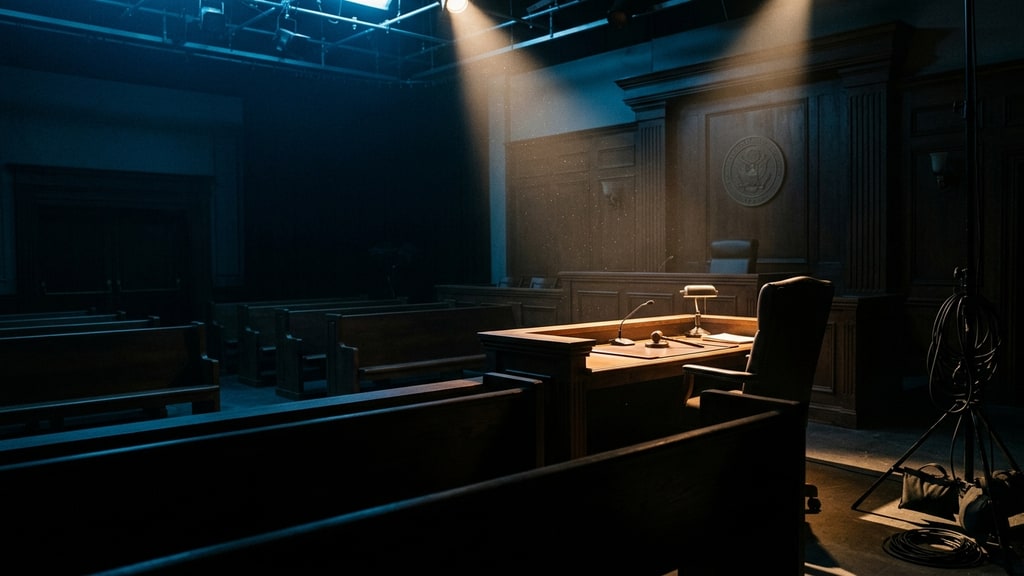
A German broadcaster just crossed a line that was mostly discussed hypothetically. RTL, working with Constantin Entertainment, took five finished episodes of a daily court show and used generative AI to change what happens in them. Characters were replaced, plot lines altered, new verdicts inserted. The episodes air in the show's regular afternoon slot, not as a tech segment about themselves.
The show is "Ulrich Wetzel – Das Strafgericht", a scripted format of fictional courtroom trials that has run since 2022, with an earlier incarnation from 2002 to 2008. The alterations are not cosmetic. According to the broadcaster, one episode had an acquitted defendant replaced with a convicted perpetrator. In another, a mother and son became siblings. A confession was inserted into a case that did not have one. A gender swap in one episode, per the network's framing, rotates the perspective on the entire story.
The production pipeline combined image editing, speech synthesis, and lip-sync adjustment, described as a multi-stage process. Rights were settled with those involved, and all five altered episodes were, in the network's words, editorially owned and legally reviewed.
That sentence is the whole story. Everything in it is now unremarkable technology. Face replacement, voice synthesis, and lip-sync correction are commodity tools. What is new is the container they arrived in: a linear broadcast slot, a rights-cleared catalog, a legal review, and a network calling the result a "practical test under real production and programming conditions" while stating a goal of 150 million euros in AI-related revenue by 2030.
Why a daily court show
The format choice is more informative than the announcement. A weekday courtroom drama at 15:55 is about the cheapest scripted content a network airs, with some of the tightest economics. Casts are small: a judge, a defendant, a witness or two. Scenes are static; everyone stands or sits in one room. Continuity demands are low because viewers do not carry yesterday's blocking into today's episode. Change a verdict and you have a new episode of a show whose premise is literally the same room every day.
Compare that to changing a plot in a prestige drama. There, a single altered scene collides with season-long arcs, shot geography an audience remembers, and a lead performance threaded through eight hours of footage. The intervention cost is enormous because the interlock density is enormous. The court show has almost no interlocks.
So the first broadcast-scale AI rewriting did not land on prestige television for the same reason erosion starts at the edge of a field, not the middle. Low-interlock content feels the pressure first. Daily soaps, game show B-roll, background artists, ad variants. If you make any of this, the applicability question is not whether but which of your interlocks is thinnest.
The edits are structural, not cosmetic
Worth pausing on what these edits are. Replacing an acquitted character with a convicted one is a narrative change: the episode now argues something different. Mother and son becoming siblings rewrites the stakes of testimony. An inserted confession changes the audience's knowledge state. These are writer-level moves executed in post-production.
Post-production has historically been where intent goes to be approximated. You can recolor, retime, cut around, but you cannot make a character have said something else. The paragraph of tools RTL lists, image editing plus voice synthesis plus lip-sync adjustment, is precisely the minimum kit for making a different version of a thing that was already shot. Nothing in that kit generates a performance from nothing; all of it edits an existing one into a different one. The catalog becomes mutable in a way it never was, and a "praxistest" is the right word for finding out where that mutability stops paying.
The network itself says the test showed where processes and technology still need improvement, which is the polite version of the same question. Anybody who has tried lip-sync retiming at length knows it is the boundary of the toolkit: convincing when the delta is small, hollow when the new line is longer than the old take.
The familiar risks are doing their laps
There is a version of this news that runs on the likeness-and-labor track: performers whose footage can be re-purposed into episodes they never agreed to, editors whose work can be rewritten downstream, the consent boundary moving from the shoot to an indefinite afterwards. Those concerns are live and covered well elsewhere, including in our look at microdrama studios recasting shows with AI versions of actors, where the pattern was already visible in the vertical-video economy. The broadcast-scale version raises the same questions with a bigger legal department attached.
The part that gets less attention is downstream trust. A court show's entire premise is that the outcome is uncertain; once audiences know outcomes are editable, the format's tension rides on whether the edit was any good. "Editorially owned and legally reviewed" answers the institutional question. It does not answer whether the edited episode is dramatic, which is the question a network actually airs on.
What a creator should take from it
Strip away the broadcast context and this is a workflow result: a library of finished material, a set of structural changes specified by humans, and a generation stack that executes the changes while preserving everything not named. That shape is portable:
- The unit of production is shifting from the shot to the shot's parameters. The catalog is the asset; the specific cut is an instance.
- The editorial skills that matter are now change specification and review. Deciding that the verdict should flip is the creative act; the flip itself is plumbing.
- Formats with low continuity interlock are the proving ground. If your content has episodes that stand alone, it is exposed first, both as risk and as opportunity.
The adjacent capability, for anyone selling things rather than airing them, is the same edit logic pointed at catalog imagery, which is where the targeted-editing discipline for marketplace photos already lives: name what changes, protect what does not, review against the original.
RTL framed the five episodes as making AI's possibilities "directly experienceable" for the audience. What the test actually demonstrates is narrower and more useful: the economics cleared the bar in the cheapest scripted format on the schedule, with rights settled before a frame aired. That is not the arrival of AI television. It is the arrival of AI post-narrative editing at broadcast quality, in the format that could afford to try it first. Watch the soaps, not the trailers. The erosion always starts where the soil is loosest.