Actors Are Losing Roles to Their Own AI Clones
Microdrama studios are remaking vertical shows with AI versions of the original actors. The pattern says more about incentive structures than about model quality.
AI-assisted draft. Reviewed and edited by the Phosphene team before publication.
On this page
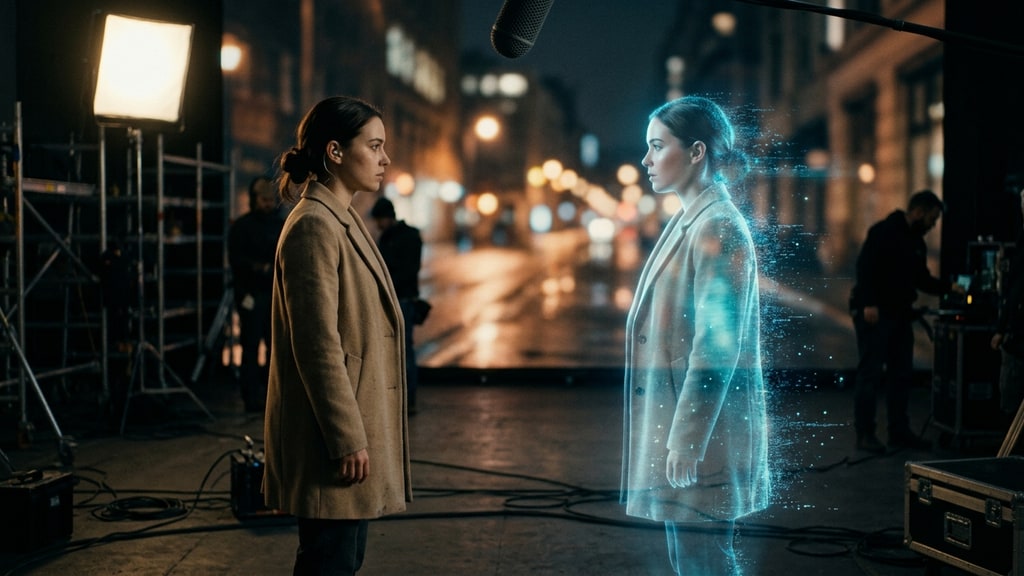
Early AI coverage kept saying the same thing: the people who should worry are the invisible ones. Writers, VFX technicians, editors. Faces were supposed to be safe, because a face is the one thing an audience can recognize. That assumption is falling apart in a corner of the industry that most of Hollywood ignored until recently: microdramas.
These are vertical short dramas, episodes around a minute long, shot on very small budgets. The format exploded in China, crossed into the United States, and now moves around 1.4 billion dollars a year there. A single hit title can earn 12 to 15 million dollars. That combination of cheap production and serious revenue changed how at least one studio thinks about its cast, and the result is a pattern worth studying if you generate people with AI.
The case that made this concrete
Ashley BeLoat starred in "Hate the Way I Love You", a 40-episode MoBoReels microdrama about a couple whose marriage falls apart after a cancer diagnosis. Months after filming, she found a new series on the same app. Same script, same settings. Different protagonist: younger, hair fuller, features smoothed to a point that reads as artificial, and a voice that was extremely close to hers without being hers. The clone series is called "Love You, Leave You". MoBoReels has not responded to her complaint.
The detail worth pausing on: the available reporting describes an AI-generated remake with a younger-looking character that mimicked BeLoat's movements and a voice that sounded extremely similar to hers. What the reporting does not establish is whether the studio reused her recorded performance, created a new voice from that recording, or filmed new scenes. That gap is the core of the problem, because it makes the remake hard to pin down.
Why microdramas are the perfect test bed
This does not happen in a studio feature film, at least not yet. Microdramas have the incentives arranged differently:
- Volume over quality. Producers want to grow the catalog cheaply, and each title costs a fraction of a TV episode.
- Vertical, one-minute episodes that are cheap to shoot and easy to binge.
- Contracts written fast, with broad editing rights, usually without any AI clause.
- Revenue per hit is huge relative to the shoot cost, so even a modest catalog boost pays for itself.
The economics line up so well that the question is no longer whether studios will try this, but how far the practice spreads before the rules catch up. The format is also moving beyond its niche: even Disney+ has its eye on vertical microdramas. ReelShort, one of the biggest players, already released an animated remake of its series "Poolboy" under the title "Under the Surface". Animation is a natural first step because it widens the gap between the original actor and the product. Live-action clones are the next rung, and that is where the current cases sit.
The pattern is wider than one studio
BeLoat is the cleanest case because the script was identical. Others report versions of the same move. Brittany Marsicek, with more than 25 microdramas on her resume, watched MoBoReels remake another of her productions with AI, "Ex-Husband, Step Aside, Lady Boss Returns". Her description of the contract situation is the most telling part. "You think maybe they will edit it from vertical to horizontal," she said. "You don't think the edit will be changing your image completely." The permission to edit was already in the paperwork. Nobody spelled out what editing would mean.
Some cases never reach the screen as a full show. Tess Dinerstein saw her image used in content that appeared to show explicit sexual material. Faith Orta saw her character partially undressed in a TikTok ad for a scene that was never filmed. These are marketing materials generated from likenesses the actors did not control, not remakes of their shows. The ad cases matter because AI-generated ad variants are precisely the use case that image-to-video pipelines make cheap.
Then there is Evan Gambardella, who hit the version with the least recourse. A different app, GoodShort, said that it does not support unauthorized use of an actor's image, voice, or identity and that the series was acquired through a third party. Gambardella said he could not prove the clone was based on his physical appearance, so he did not pursue legal action. He said he had not booked work since speaking publicly and believed he might have been informally blacklisted.
The union deal protects the wrong people
Hollywood actors earned real protections after the 118-day strike in 2023. The 2023 SAG-AFTRA TV/Theatrical Agreement requires consent for digital replicas and notice and bargaining for wholly synthetic performers. The 2026 agreement adds a "significant additional value" commitment for synthetics in covered work. These union protections do not automatically govern nonunion microdrama contracts.
That deal does almost nothing for microdrama actors. Most of them are not SAG-AFTRA members, and their contracts do not mention AI at all. Entertainment lawyer Jonathan Handel called the situation "the canary in the coal mine": the union framework protects people inside the union, while the people most exposed signed outside that umbrella. BeLoat, Marsicek, and Gambardella all did.
The same gap will appear anywhere content is produced cheaply and fast. Non-union voice work, catalog illustration, stock photography, background performers in game cinematics. Every one of those markets has the same structure: broad usage rights, low individual bargaining power, and nobody checking how those rights get exercised.
What this means if you generate people with AI
If you make images or video of real-looking people, the practical lessons are simple, and they do not require a law degree.
Keep consent on paper. The cases above did not fail because the tools were new. They failed because a contract said "editing" and the studio decided that meant replacing the actor with a synthetic version. Write down what uses are allowed, including remakes, ads, and re-releases, or assume the broadest reading wins.
Keep provenance records. The actors who could not fight back had one thing in common: no easy way to prove the clone came from their performance. If your work flows through tools that keep generation logs, session state, or image histories, that record becomes evidence. Deleting it to save disk space can cost you the ability to defend a likeness later.
Ask who owns the output. Ownership of a generated asset and rights in a person's likeness are separate questions: the contract, applicable union terms, and local law decide each one. Document ownership, consent, permitted uses, and compensation separately. Studios will keep pushing the interpretation that maximizes catalog growth. The counterweight is a better paper trail and clearer contract language, not a better model. The same multi-format reuse that solo creators use to stretch one shoot into drama, anime, and manga, as covered in our multi-format production pipeline guide, is what studios are weaponizing here.
The technology part of this story is basically settled. Cloning a face, a voice, and a performance into a new product is no longer hard. The open question is governance: who can give permission, what counts as consent, and how a performer proves that a synthetic version of them came from them. Microdramas are running the experiment ahead of the rules, and every creator working with human likenesses is going to live with the outcome.