The RTX 5090 Is Being Cut Apart for AI. What That Does to Local Image Generation
Reports from Chinese hardware channels show new RTX 5090 cards being desoldered for their GPU dies and GDDR7, then rebuilt into server boards. The card you would buy for local generation is the same card being harvested. Here is what that changes in the local-versus-hosted decision, with the arithmetic done honestly.
AI-assisted draft. Reviewed and edited by the Phosphene team before publication.
On this page
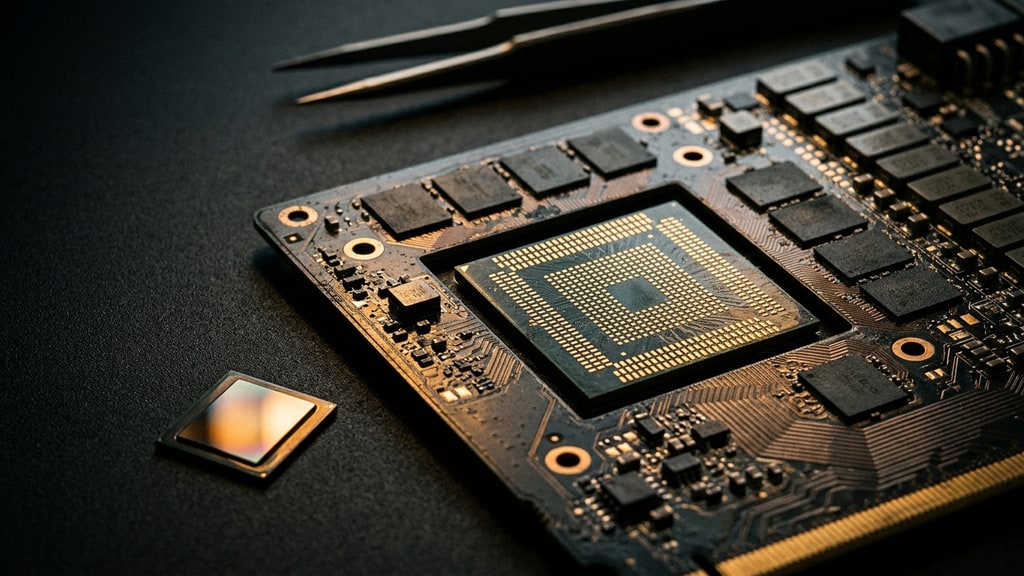
There is a specific kind of frustration in watching the card you cannot buy get disassembled so somebody else can use the part you wanted. Reports out of Chinese hardware channels this week describe exactly that: new RTX 5090 boards going to workbenches, where the GPU die and the GDDR7 memory modules are desoldered and reassembled onto custom boards for AI servers.
The story is being told as an export-control failure. It is that. It is also a supply fact that lands directly on anyone who has been telling themselves they will just build a local box when prices calm down. The memory that would have gone into a consumer card is going into a rack.
What the reporting actually establishes
The origin is HKEPC, a Hong Kong hardware outlet, which published video of the process. The Spanish coverage in Xataka adds the surrounding detail: the harvested chips go onto bespoke boards fitted with turbine-style coolers so more cards fit into a server chassis without cooking, and Tom's Hardware estimated the workshops can process thousands of cards a day.
That last number is an estimate, not a measurement. Nobody publishing this has an audit trail. What is not in dispute is the underlying constraint: US export rules stop Nvidia from selling its top consumer GPUs into China, and the RTX 5090 is one of them. Nvidia, for its part, says the 5090 is not end-of-life and is still being manufactured. Meanwhile, US retailer Micro Center has reportedly started asking some buyers of these cards to sign a declaration that they will not export them, with ID and the intended installation address.
So the picture is a card in short supply globally, a grey channel moving it into datacenter rebuilds somewhere, and retail shelves in Europe that get a trickle at prices nobody enjoys. None of that is good news for a freelance artist pricing a workstation.
Why this hits image work specifically
A 5090 is interesting to image and video people for one number: 32 GB of GDDR7 on a 512-bit bus. Not the shader count, not the frame rate in a game. Memory.
The reason is arithmetic that has not changed since the first diffusion models. Model weights scale with parameters, and at 8-bit precision that is roughly one gigabyte per billion parameters before you allocate anything for activations. A 12B image model is about 12 GB of weights. Add latents, attention workspace, and a batch above one, and 32 GB stops feeling excessive. Move to video, where the latent tensor grows with frame count and resolution, and it starts feeling tight. Below 24 GB you are offloading layers to system memory, which works and is slow, and which quietly turns a 40-second job into a 4-minute job.
The second reason is that a harvested card is not a discounted card. Desoldering and reballing is skilled work, and the boards that result are not consumer products. That removes a route that used to exist for small studios: buy used, accept the risk. If the used market starts filling with boards that had their memory pulled and reflowed, the inspection story gets worse, not better, and nobody is publishing a reliable way to tell.
The break-even math, with the assumptions visible
Every "local is cheaper" argument reduces to one division, and it is worth doing it with your own numbers instead of vibes.
Take an all-in card cost. Add the rest of the machine if you are starting from nothing, but for the comparison, use the marginal cost, because most people considering this already have a case and a CPU. Divide by your hosted cost per accepted image.
An example, clearly an example and not a price quote: a card landing at 2,400 euros against hosted generation at 0.04 euros per image gives 60,000 images to break even. Electricity on a 575 W card at 0.30 euros per kWh is about 0.17 euros per hour, so 2,000 hours of rendering adds roughly 345 euros. That pushes you past 68,000 images.
Sixty-eight thousand images is not an absurd number for a studio that runs a character pipeline and retries constantly. It is an absurd number for someone producing two campaigns a month. That is the entire argument, and it turns on your volume, not on the news.
Two adjustments that the supply squeeze forces into the math. First, the hosted side of the comparison is falling, because per-image prices keep dropping and model choice keeps widening. Second, the local side is inflated right now by exactly the distortion in this story: when retail stock is thin, you are not paying market price, you are paying scarcity price, and scarcity price is a bad basis for a three-year depreciation schedule.
Three profiles, three answers
If you generate a few hundred images a month and mostly care about iteration speed, hosted is correct and always was. You get model versions you did not have to install, no driver archaeology, and no capital tied up in a card that will be mid-tier in 18 months. The only local exception is confidential client work that cannot leave your machine, and that is a compliance decision, not a cost one.
If you run a pipeline with a consistent character or product look, the calculus shifts toward local for a different reason: reproducibility. Owning the weights, the LoRA, and the exact inference stack means a render from March still reproduces in October. That is worth real money when a client asks for one more frame in the same style. Note that this argument comes from continuity, not from per-image cost, so do not let it talk you into a card you cannot afford. A rented GPU with a pinned image and pinned weights gives you the same continuity.
If you are producing video at volume, local makes sense at the high end or not at all. Video is where VRAM stops being a preference and becomes a wall, and it is also where hosted per-second pricing adds up fastest. This is the one profile where a 32 GB card genuinely pays for itself, which is unfortunate, because it is also the exact card being harvested.
What I would actually do this quarter
Do not buy at scarcity prices to solve a problem you have in November. If you need throughput now, rent it, and write down what you are paying per accepted output so the comparison later is real instead of remembered. Revisit when retail stock normalizes, and treat "the 5090 is in stock at a normal price" as the signal, not a rumor about a price cut.
If you do buy used, inspect the card before money changes hands: run a memory error test long enough to heat soak it, check that reported memory bandwidth matches the spec rather than the bus width on the box, and look at the board under light for reflow marks around the memory packages. None of that is conclusive. All of it filters the obvious cases.
And keep the decision reversible. A workstation built around one enormous card is a bet that the next model generation fits in it. A machine with two mid-size cards and a fast interconnect is a bet that it does not. Given that the interesting video models keep getting larger, I would rather hold the second bet, even though it costs more per gigabyte today.
The uncomfortable part of this story is not the sanctions angle, which will keep producing headlines. It is that consumer VRAM is now competing directly with datacenter VRAM for the same physical parts, and datacenter buyers do not flinch at price. That competition does not resolve in favor of the person editing thumbnails on a Tuesday night.