Nineteen AI-Made Books and the Constraint Video Does Not Have
A Japanese AI creator award opened its publishing field: 29 entries, 27 on a public gallery, most of them readable for free on the web. The entries that hold up share a navigation structure and a stated editorial position, not a page count.
AI-assisted draft. Reviewed and edited by the Phosphene team before publication.
On this page
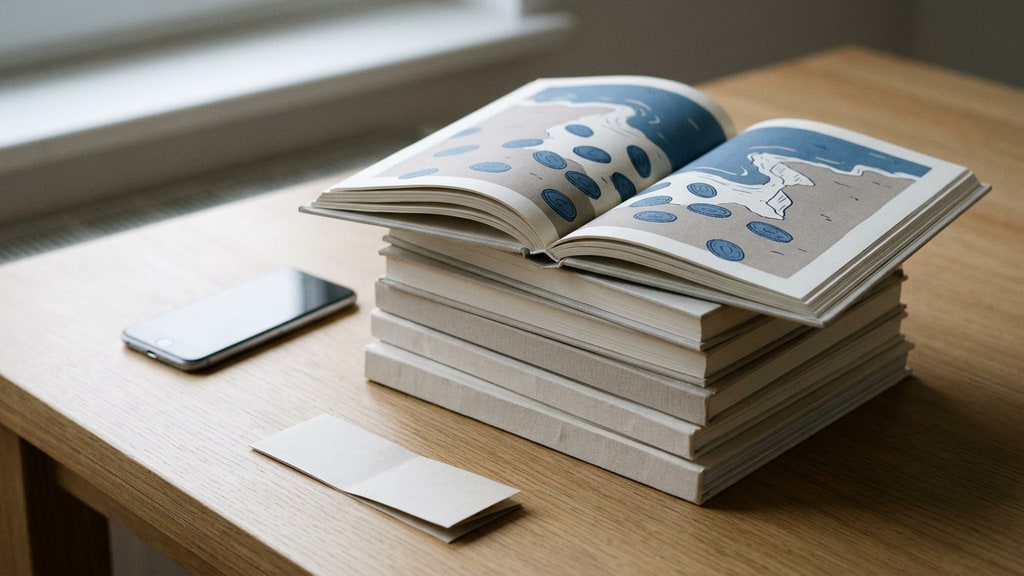
Video entries to an AI award get watched in a few minutes. Books have to be opened. The organisers of the International AI Creator Award 2026 made that observation while introducing their publishing field, and it is the most useful sentence in the whole announcement. It names the constraint that separates publishing from every other category in the competition.
The field's numbers as of 23:30 Japan time on 1 November: 29 entries, 27 of them live on the public gallery, spread across Japan (22), Korea (3), Brazil (1), and Canada (1). Twenty-five are eligible for the public vote. Eight of the 27 gallery items are the organisers' own publications, which leaves the 19 works this piece looks at. The gallery had collected 55 emoji reactions and 8 written comments at that point. The organisers listed their own books in the same field and said plainly that they are the organisers' work, which is the kind of disclosure that costs nothing and buys credibility.
What follows is not a ranking. Entry order in the announcement is publication order, and 55 reactions is not demand data. The interesting material is what the projects do structurally, because a field where page production is nearly free forces every entrant to answer a question that video creators can dodge: why would anyone finish this?
When pages are free, structure is the product
The entries that stay in my head are the ones with a rule the reader has to work inside.
BLUECOIN is a search-and-find picture book with 91 blue coins hidden across 13 landscapes, from a Japanese summer festival to an Antarctic research station to the Earth seen from orbit. The world map spread was built from actual coastline data rather than improvised. That is a book whose value is a contract with attention: you cannot skim it, because the task is scanning. The technique underneath is a generated illustration pipeline pointed at a puzzle design, and the puzzle is what makes the illustrations load-bearing.
読めない博物誌 (roughly, an unreadable bestiary) goes the other way. The author explored a model's latent space looking for eight creatures that resemble no existing organism, then wrote what can only be written about them: "Not a dragon. Not a worm." Each creature is named in a script the author invented, and the pronunciation key sits at the back of the book. The taxonomy is the book. Strip out the invented naming system and you have eight strange animals, which is a folder, not a publication.
flutter soda builds a near-future Shibuya across 13 chapters and 23 images, following a girl named YUNA, with the light and colour palette shifting chapter by chapter. Serial attention again, this time held by a visual rule rather than a puzzle. 雪明かりの七不思議 runs a seven-chapter campus mystery, starting with a man found in a university cafeteria freezer, where the incidents happen in the order of an old fairy tale collection, so the structure is also the clue system.
Four different genres, one shared trait: the reader is given a route. Generated pages are cheap, so a stack of them is worth nothing. A route through them is the deliverable.
The entries that state a position
The second pattern is editorial. A few projects say out loud who is responsible and what the book refuses to do, and that statement is doing real work in a field where the default assumption is that nobody decided anything.
WAYFARER Edition is an English-language digital publication on travel, culture, and design from a Brazilian editorial perspective. The listing states that editorial responsibility sits with a human and AI is used in support. That sentence is not decoration. It tells a reader how to weigh a claim, and it tells a jury that the human contribution is a judgment rather than a prompt.
The Discovery, from Korea, is a record of a dialogue that began with the question "what do you think?" and kept the actual conversation, including corrections and disagreements, instead of rewriting it into a clean conclusion. Keeping the mess is the harder edit and the more honest artifact.
MUJIGAE, a Korean pet-loss story, works from memories of a real dog and cat. The author's note says the point is not to reproduce the animal that died but to value the life and the bond that existed. That is a decision about what generated imagery is allowed to do, made before any image was made, and it is the difference between a memorial and a deepfake of someone's grief.
One more detail worth flagging: the Mika story by Nagao Atsushige appears twice, once in Japanese and once as an English edition titled Artist by Artist: The Story of Mika. Treating translation as a second submitted artifact rather than a post-launch chore is rare, and it is the kind of thing that decides whether a book crosses the border the award is named after.
The object still earns its place
Only one entry in the field is built around a physical thing, and it is the one I would study. EMKO's book on making music with Suno covers the songs, the jacket design, the printing, and an NFC tag that takes a phone to the audio. The book is the interface to the recordings. A PDF of the same content would be a tutorial. The printed object plus a tap is a product.
That is not nostalgia. It is distribution logic. If the content is free to reproduce, the copy that carries a physical or interactive affordance is the copy someone keeps.
What the field also reveals about distribution
Most of these books live on the open web: serialized on note, posted on pixiv, uploaded to YouTube. That is the practical answer to a market where an ISBN, a printer, and a distributor are three separate costs. It also means the bottleneck moved. Production is not the constraint anymore. Being found is.
Read the award's own mechanics in that light. Public voting is free, one work per field, and it closes on 13 November (Anywhere on Earth), which is 21:00 Japan time on 14 November. The gallery asks readers to leave a comment for the author rather than only a vote. For a field of 27 works with 8 comments, the comment box is a more realistic distribution channel than the ranking.
If you are making one of these
Two things to settle before generating a single page.
First, the route. Decide what the reader does that a video viewer cannot: search, cross-reference, follow a chapter rule, decode a naming system, handle an object. Write that rule down in one sentence. If the sentence is "look at the pictures," the project is a portfolio, not a book.
Second, the position. Write the line about who decided and what the book will not do. It takes ten minutes, it protects you when a reader asks why a generated image handles a real memory, and it is the part a jury remembers.
Then choose the artifact. A free web serialization gets reach. A printed object with a tap target gets kept. The two are not competing, and the projects that understand this ship both.
One caveat about the data: 29 entries from four countries, announced by the organisers on the day the field opened, is a snapshot of one award, not a census of AI publishing. The Japanese share is heavy and the engagement numbers are tiny. Read the structural patterns, not the vote counts.
The field's gallery and voting page are public if you want to read the entries yourself rather than take my summary of them.