A Serialized AI Manga, Remade From Scratch in a New Tool
After a year and a half of serialization, the AI horror manga YOUKAI rebuilt its first episode in Anifusion from zero. A remake is the sharpest test of a creative tool you can run, and the Japanese writeup of this one is unusually honest about what broke. What the exercise reveals about character consistency, per-panel staging, and the skills that actually gate AI comics now.
AI-assisted draft. Reviewed and edited by the Phosphene team before publication.
On this page
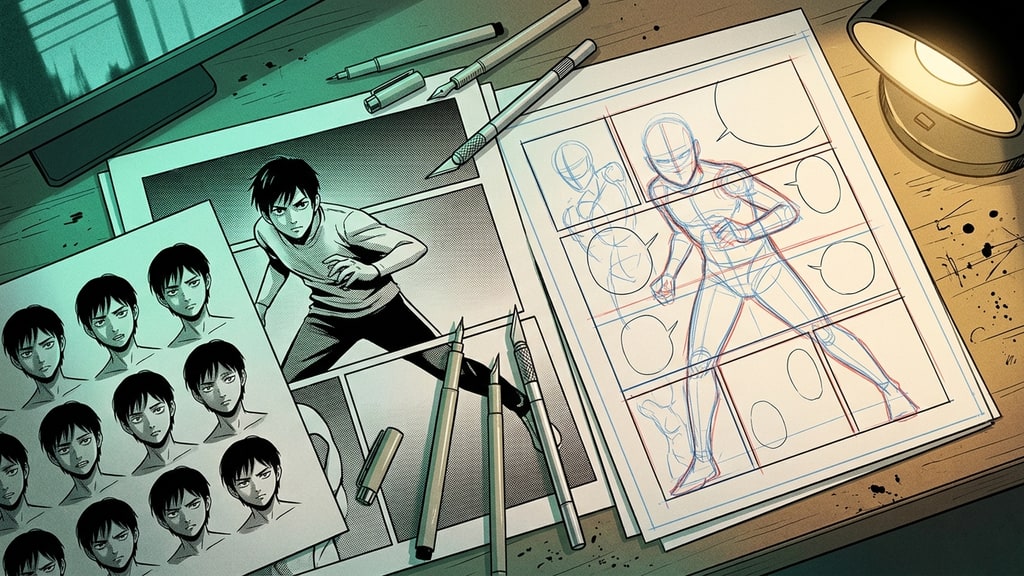
The fairest test of a creative tool is not a demo. A demo is staged by the people selling the tool. The fairest test is taking work you already finished, work you have opinions about, and rebuilding it from zero in the new system. Same story, same characters, new instrument. Whatever breaks, breaks in public.
That is the experiment at the center of AICU Magazine Vol.27, the August issue of the Japanese creative-AI publication, which is devoted entirely to AI manga production. The flagship piece: the school horror serial YOUKAI, which has been running for about a year and a half, took its first episode and remade the whole thing in Anifusion, a dedicated AI manga platform that handles page layouts, character reuse, speech bubbles, and editing in one place. The author, an AI manga artist publishing as Karao, had already made this episode once. The remake was not about shipping it again. It was about finding out where a manga-specific tool actually helps and where the old problems just follow you in.
Why a remake tells you more than a fresh project
A new project cannot separate the tool from the story. If the pages come out mediocre, you do not know whether the concept was weak or the pipeline was. A remake controls for that. You already know the episode works, panel by panel, because readers have read it. Most of what differs between the two versions traces to the pipeline rather than the material. Not everything does, though: a remake rebuilds prompts, staging, and editing decisions along with the pages, so the comparison is informative rather than a controlled experiment.
There is a second benefit that matters more for anyone publishing serials. A year and a half of episodes means an accumulated idea of who the characters are: how they hold themselves, what their faces do under stress, how much they can deform before readers object. Remaking episode one drags all of that accumulated knowledge back onto the bench. You discover which parts of your character you can actually specify and which parts only ever existed as habit. That is exactly the knowledge AI comic work runs on, and most creators never audit it.
The writeup of the remake, as the issue's editors describe it, is a process record rather than a highlight reel: how character consistency was held across panels, where composition and staging got real effort, and the failures along the way, documented instead of cropped out. Failure documentation is the rarest genre in AI creative writing. Anyone can show the panel that worked.
The problems that did not go away
The remake's central subject is character consistency, which remains the load-bearing wall of serialized AI comics. The tooling has answers now: character libraries, reference reuse, per-panel regeneration. Anifusion's pitch is that layout, characters, and bubbles live in one editor, so a fix does not mean rebuilding the page around it. The writeup documents panel-level generation and page editing as supported; whether one regenerated panel leaves every neighbor untouched is a per-case question, not a documented guarantee.
But consistency is not only a feature problem, and the remake makes that visible. A character who reads as the same person across a year of chapters is consistent in more than facial geometry: silhouette, wardrobe logic, how emotional the art lets them get. Some of that can be encoded in a character sheet. Some of it is judgment applied panel by panel, and the remake had to re-apply all of it, this time against a tool that wanted to help in different places than the previous pipeline did.
That tracks with what we have covered before in this space: consistency behaves like a system you design, not a checkbox in the generator, whether you are working in PixAI panel-by-panel or building a character consistency system for image work generally. A new tool changes the cost of each decision. It does not remove the decisions.
The scene around the experiment
The issue surrounds the remake with the ecosystem that produced it, and the collection is a decent snapshot of where Japanese AI comics sit right now. A monthly contest ran three divisions around the same tool: one for explaining Anifusion itself, one inviting readers to submit their own YOUKAI pieces, one for standalone short works, judged by AICU's editor and the remake's author. A vertical-scroll web reader for YOUKAI launched alongside, built for phone-native reading rather than page-native. Japanese AI manga coverage has already worked through the production pipeline question at community scale; this issue is what the second wave looks like, where the interest shifts from can you make it to is it worth reading.
One more piece deserves mention because it reframes what AI production is for. Tsuyoshi Sone, the cinematographer of One Cut of the Dead, the famous micro-budget zombie film, adapted a work by horror manga grandmaster Hino into an AI film. The framing in the issue is not efficiency or cost. The production places the original author and the memory of his late wife inside the same frame, preserving a memory in a form it could not otherwise take. Against a discourse that treats generated imagery as a compression scheme for labor, that is a different and older use of the technology: as a way to keep something.
The actual gate now
The issue's editorial line is blunt about the moment. Four years since image generation arrived, "I can't draw" has stopped being a reason to not make the story you have. The barriers that fell were technical, and the last one to fall was craft itself. What is left as the differentiator, in the editors' phrasing, is what you are driven to say, and whether you can carry a project through finishing, publishing, and reaching readers.
That matches the evidence in the remake. The tool absorbed layout, bubble placement, and consistency plumbing. What the author spent the effort on was staging: what each panel argues, when a beat lands, how much a face is allowed to do. Those are storyboard decisions, and no manga generator makes them easier, because they were never drawing problems in the first place.
For someone starting now, the practical reading of the issue is a division of labor: let the tool own the mechanics, put your hours into the shot list. That is the same split we build templates around, encode the repeatable parts of a workflow, keep the judgment with the person. A remake of your own old work, in a tool you are evaluating, is still the cleanest way to find out which side of that line you are actually standing on.