Announce the Workflow, Not the Headcount
A quality executive at China’s best-known chili crisp brand mentioned record revenue and AI inspection cameras in the same breath. Four days later the story was about hundreds of lost jobs, and the number everyone shared did not measure what they said it measured.
AI-assisted draft. Reviewed and edited by the Phosphene team before publication.
On this page
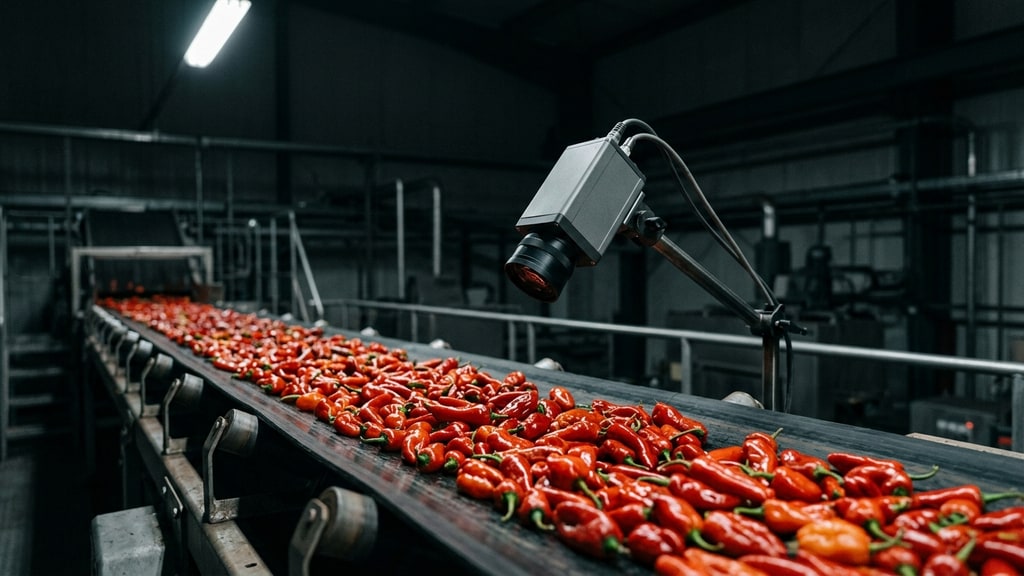
In mid-October, at a quality conference in Guizhou, a Lao Gan Ma quality executive named Li Xin gave the room two facts about the company. Revenue for 2025 came in around 5.4 billion yuan, a record. And the plant in Guiyang now runs industrial cameras over the line that scan the belt every 0.3 seconds, reject peppers with mould or blemishes, and leave defective product at 0.02% at that stage.
Both statements are probably accurate. Said one after the other, they cost the company a week of its reputation, because the audience did the arithmetic that the sentence invited. China's most recognisable chili crisp brand had just described better quality control and a very good year in the same breath, and a country currently anxious about automation heard only one of them.
What was actually claimed
The revenue figure is real but thin. In 2020 the company had already posted 5.403 billion yuan, so the historic high is historic by a rounding error. The 0.02% figure is also narrower than it travels: it describes defect rates at the inspection stage, not the plant's overall quality.
Neither qualification was in the room. A quality conference is where you talk about process, and by any reasonable reading the executive was describing a system that works. That is the part that makes this instructive rather than ridiculous. He was not lying. He was announcing.
What the rumour added
Within days, posts circulating on Weibo claimed the AI system had cut the pepper inspectors from 600 people to 48. A widely shared thread on X put the rumour at more than 500 layoffs. The company said the information was false. An HR employee told Ifeng that AI is used for inspection, that there were no mass layoffs, and that the company never had that many workers in that role to begin with.
That last point is the one worth sitting with, because it is almost impossible to prove from outside. Lao Gan Ma has not published how many people sorted peppers before the cameras and how many do it now. Everything the public has is a denial and a set of headcount figures that were collected for a different purpose.
The number that made it stick
The figure that travelled furthest was this: headcount fell from 2,912 to 740 while revenue sat at a record. That is a startling pair of numbers, and it is not a measurement of inspectors.
It is the insured-worker count for the parent company. It covers the whole company rather than one role, it excludes subcontractors, seasonal staff and people employed by subsidiaries, and it cannot distinguish between restructuring, natural attrition and contracts that simply were not renewed. The "more than 2,600 fewer" version that spread on social media came from adding branch offices onto the parent figure.
So the evidence chain went like this: a real automation claim, plus an unverified rumour about one job category, plus an entity-level headcount series that measures something else entirely, assembled into a story that felt proven. Insured-worker counts are the kind of data that looks like an audit and behaves like a rumour, because they are precise without being specific.
This is a mistake creators make constantly, usually in good faith. "This took ten minutes instead of three days" is a real number about a real render. It is not a number about the project, which still needed a brief, references, three rejections, an upscale and a colour pass. The number is true and the claim it is attached to is not, and audiences have become fast at spotting the gap.
Why the denial arrived too late
Part of it is the policy backdrop. China's AI Plus plan from last year targets 70% adoption in strategic sectors by 2027 and 90% by 2030, and a substantial share of the public is not enthusiastic about that schedule. A chili brand that supplies a staple and employs people by the thousand is a much easier place to argue about it than a policy document.
The rest is a pattern library the audience already has memorised. Klarna said its assistant was doing the work of 700 agents, and a year later its CEO said the company would hire humans again. Commonwealth Bank reversed 45 customer service redundancies and apologised. Salesforce's support organisation went from about 9,000 people to roughly 5,000, and Duolingo replaced contractors. Careerminds found that a third of companies that cut roles citing AI have since recovered between a quarter and half of them.
When walk-backs outnumber clean wins in the public record, an announcement of automation gets read as the opening line of the next walk-back. The company's denial was specific and, for all anyone knows, true. It arrived after the frame had already set.
What the aggregate data says, which is less dramatic
The New York Fed found that only 1% of firms said they had laid off workers directly because of AI. Of the more than 1.2 million job cuts announced in the United States during 2025, about 55,000 were explicitly attributed to AI. Ben Thompson's argument, which Xataka also cites, is that a lot of current cuts look more like the unwinding of pandemic over-hiring than like substitution.
The exception is more interesting than the headline. Stanford found no broad displacement, but employment among 22 to 25 year olds in highly exposed occupations is running about 19% below where it would be expected, because hiring slowed. The damage shows up at the entrance rather than the exit. Junior work is where a system gets tested, and junior work is what a camera over a conveyor belt removes first.
Which is why the laziest version of this story, "AI did or did not take the jobs", misses what actually happened. Lao Gan Ma did not get in trouble for automating inspection. It got in trouble for pairing a labour-adjacent claim with a financial one in public, in a year when every such claim is treated as a confession with a delay.
What to do instead, if you sell creative work
The rules transfer almost intact, because creative work is now described in exactly this vocabulary: faster, cheaper, fewer hands.
Say which step changed, not what it saved. "The first pass of forty thumbnails is generated, and I choose and finish from there" is a claim a client can check. "AI cut my production time by 80%" is a claim that invites them to wonder what else got cut.
Name the checkpoint a human still owns. Clients are not buying the absence of people. They are buying a decision with a name attached to it, someone who will look at the frame and say this one, not that one. If nobody owns the call, the work has no author and therefore no one to hold responsible, which is a worse deal than a slow one.
If you cite a metric, say what it counts. A defect rate at one stage is a good number. It is not plant quality. A render time is a good number. It is not the project. Most of the credibility damage in this story came from a figure that was accurate and mislabelled at the same time.
Price the output, not the headcount. This is the same ground covered in what clients actually pay for once video gets cheap. A client who hears "this used to take three days" learns to renegotiate the price. A client who hears "we removed the people who checked it" learns to check.
Keep the trail. Versions, references, prompts, the rejects. If a client can see what changed between pass one and pass five, you never have to claim anything about your process, and there is nothing for a rumour to fill in. That is also the durable answer to the broader suspicion aimed at AI-made images, which we wrote about in why people hate AI posters: the resentment is rarely about the tool, it is about not being able to see the work.
The uncomfortable part
It is entirely possible that the cameras improved quality and nobody lost a job. Nothing published so far can establish either version, because the one number that would settle it, how many people sorted peppers in 2022 versus now, has not been released.
What is established is the cost of the sentence. On one e-commerce platform, daily sales for the brand dropped from a range of 5,000 to 10,000 yuan to a range of 1,000 to 5,000 after 22 October. For a company that barely sells online and holds roughly 55% of the national chili sauce segment, that is small money. It is also the first time in years that a brand built on a grandmother's face on a jar has had to explain itself on Weibo.
The lesson is not that companies should hide their tools. It is that the announcement is a separate artifact from the automation, with its own risks and its own audience, and it deserves its own editing pass. Describe the step. Keep the headcount out of it. Let the work argue.