Faking a Day in Nine Frames: The Prompt Formula Behind the Viral Camera Roll Trend
Give an image model one reference photo and ask for a full day back: nine candid frames from morning to night, arranged like an iPhone camera roll. The trend spread across X because the result feels like evidence of a life that was never lived. Here is the formula that makes it work, from a Japanese creator who failed twice before it landed.
AI-assisted draft. Reviewed and edited by the Phosphene team before publication.
On this page
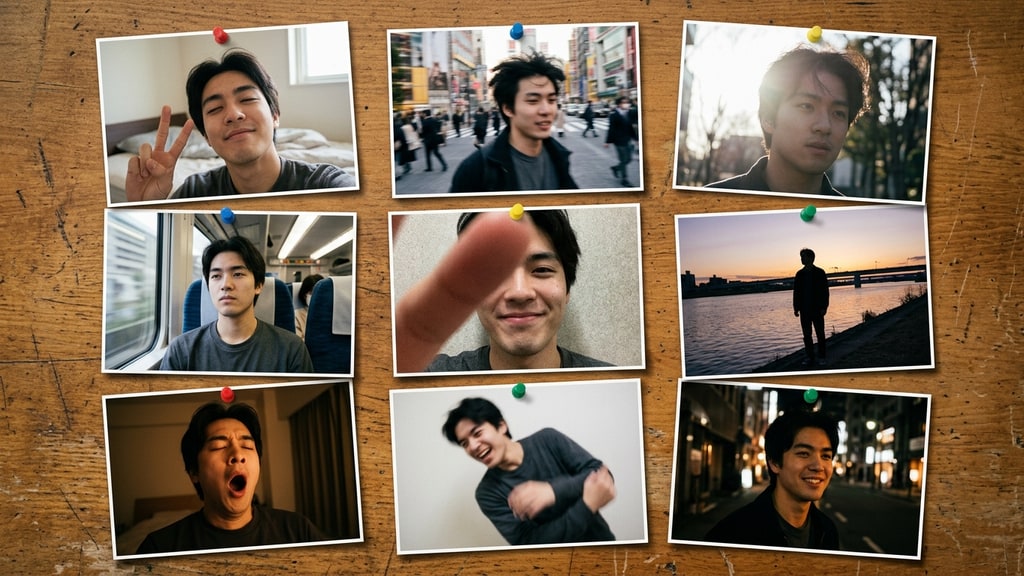
In mid-September 2026, a prompt shape started circulating on X: hand the model one reference image of a person and ask for a day's worth of camera roll, nine frames in a 3x3 grid, morning to night, styled like the iPhone Photos app. Within hours it had spawned self-deprecating variants, mascot versions, and a wave of imitators.
The mechanic is not the once-popular "one polished image" game. The version that spreads requires something harder: nine cuts that all agree on who the person is, while still carrying the blur, the framing accidents, and the deadpan boredom of actual phone photos. Consistency and sloppiness at the same time, on the same grid.
A Japanese creator who goes by MINATO ran the exercise three times and documented why the first two attempts collapsed. The failure pattern is predictable, and the fix is a reusable template.
Failure one: the abstract prompt produces nine copies of one pose
The first attempt was a single polite sentence: same person, one day, morning to night, 3x3 grid, nine images, camera roll style. The model returned nine similar selfies. Same angle, near-zero expression variance.
The cause is not model stupidity. "Spent a day" is a request for a day's worth of different events, but it never says what those events are. When a model has to draw the same subject nine times with no concrete instruction to differentiate, it converges on the composition that costs it the least effort. You get variance only when you specify variance.
Failure two: real scenes, broken fingers, and a timelapse that went backward
Attempt two added a concrete situation per frame: peace-sign selfie, walking back view, backlit close-up, blank expression on a train. Composition variety arrived. Then two things broke.
First, the classic body-part failure: selfie fingers. One frame had too many fingers, another stretched them unnaturally. Second, chronology collapsed. The grid's fifth cell showed night and the eighth showed morning light. Each frame described a time, but the model never learned that grid position itself meant time. Position was decoration, not data.
Failure three: constrain the order, and engineer the flaw
The rewrite that finally worked did two specific things. It bound grid position to time of day one-to-one: top-left is morning, bottom-right is night, cell five is where the day turns. And it stopped trying to hide the finger problem, promoting it to a planned "failed shot" instead.
The resulting prompt, translated:
Using the person in the attached image as the protagonist, generate a 3x3 grid of nine images that looks like the camera roll of a day from morning to night, styled like the iPhone Photos app. The grid position corresponds to the passage of time: top-left (1) is morning, bottom-right (9) is night.
- Morning, peace-sign selfie
- Late morning, blurred back view while walking through town
- Noon, backlit close-up of the face
- Mid-afternoon, expressionless shot that looks like it was taken on a train
- Before evening, a failed-looking shot with a finger at the edge of the frame during a selfie
- Evening, full-body shot by the river
- Evening, yawning face
- Before night, a twisted pose
- Night, close-up with the hair up
Remove any processed or illustrated look. Keep the natural image quality, camera shake, and lived-in feel of an actual phone photo.
The result, by the author's own account, was unsettling. The failed fifth frame and the dead-eyed train shot read as genuinely taken that day, and the sequence carries a felt arc from morning to night. Data assembled deliberately became an experience.
Why the third attempt landed
Two mechanisms did the work.
The first is explicit mapping. "Chronologically" means nothing to a model unless the order is stated as a spatial rule it can follow: this cell equals this time. The grid is a coordinate system, so treat it like one.
The second is the harder idea, and the author draws it from his earlier character-consistency tests. When a model has a known weak point, fighting it makes the output worse: scrubbing the artifact draws attention to it. If instead you decide in advance where the image is allowed to break and write that break into the prompt, the flaw reads as intention. A finger in frame is an error. A finger in frame at cell five, between a walking shot and a riverside shot, is realism. The same logic applies to blur, motion streaks, and blank expressions: pick the failure slots, fill them deliberately, and the model stops inventing failures where you did not plan them.
The reusable formula
Five rules, from the author's write-up, that survive contact with other subjects:
- Use one reference image with the face and hairstyle clearly visible.
- Bind grid position to the timeline one-to-one. State it in the prompt as a rule, not a wish.
- Give every single frame its own concrete sentence: action plus situation. Stop at "a day in the life" and the model will fill the frames with the least effortful version of that.
- Budget one or two deliberate flaw cuts. Finger in frame, motion blur, dead expression, pick them and name them.
- Close with the quality instruction: kill the processed and illustrated look, keep natural phone quality and camera shake.
The template generalizes beyond fabricated days. Any series with an inherent order, a character traveling through a timeline, a product appearing in a morning-to-night usage arc, a model of the same principle: spatial position carries meaning, so encode the meaning into the position explicitly, and let the model's known weaknesses become part of the story instead of a defect to hide.