Why AI Tools Exhaust You More Than They Save You
Generative models cut your working time and still leave you drained by the end of the day. The reason is not the hours; much of it is the added cognitive load of checking, sorting, and rejecting output. Here is how AI brain fatigue works, and how to stop it from quietly switching off your own thinking.
AI-assisted draft. Reviewed and edited by the Phosphene team before publication.
On this page
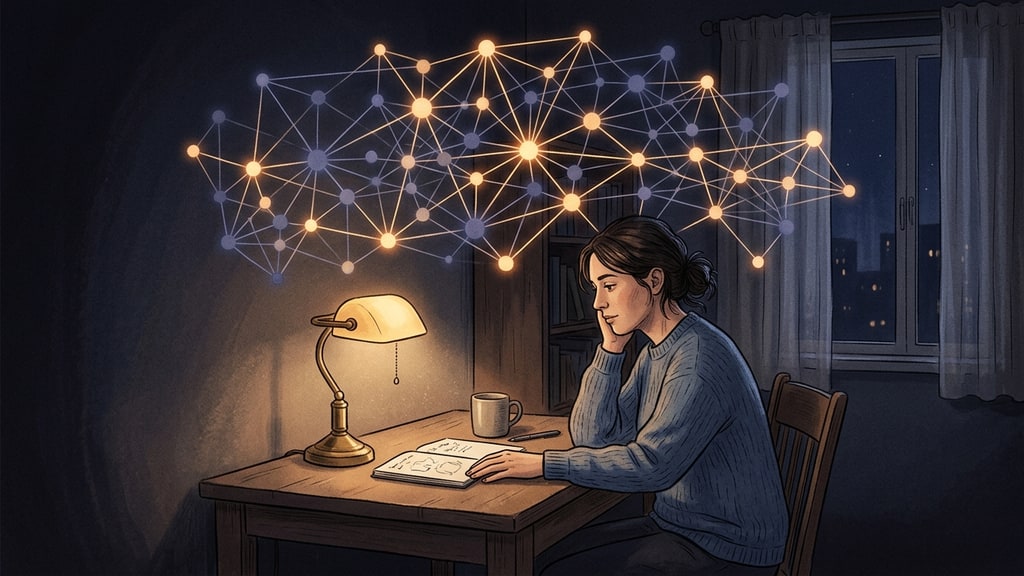
You saved two hours with AI today and you still finished more drained than if you had done the work by hand. This is not a figment of a bad day. There is a name for it now, and it comes from a place you would not expect: a neuroscientist.
The concept was laid out by Hiromu Monai of Ochanomizu University, who works on brain fatigue, and it travelled out of the lab through a piece by a Japanese AI director on the note.com platform. Monai's point is that generative models cut the raw work time, but they add a different kind of load that quietly cancels the win out. You spend less time producing and more time receiving, checking, and sorting information. The article frames that state — incoming material growing faster than your ability to process it, so passive consumption becomes a source of stress — as an "information metabolic syndrome." It is an explanatory framing from that article and the director's account, not a formally established or Monai-coined medical term.
Time saved is not the same as a relaxed brain
This is the counter-intuitive part that mostly gets missed. Shorter working time and an easier brain are not the same thing. When the actual output takes seconds, the effort moves into deciding which of the many outputs is worth keeping. You are not doing fewer decisions. You are doing a different kind: quick, repeated, and constant, across every single generation.
Anyone who has used an image generator seriously has felt the shape of this. The task that used to take an hour now takes four minutes plus forty minutes of "is this one right, or should I try again" judgement that you do not really clock as work. The fatigue did not disappear. It changed flavor.
Passive use quietly dulls your thinking
There is a well-known cognitive trap here that a passive workflow walks you straight into. A generative model answers along the context of your question, so a biased prompt can push toward a biased answer — though the output varies by model and context. Ask the model to confirm a direction you already like, and it may well agree. Repeat that enough and the tool stops being a thinking aid and becomes a confirmation machine.
The giveaway is the pattern described in the original article: the more you accept answers and skip the step of testing them yourself, the more your instinct for judging results atrophies. It uses a 1963 experiment by the psychologists Held and Hein as the metaphor (Held & Hein, "Movement-produced stimulation in the development of visually guided behavior," 1963). Kittens carried around in a gondola, moved passively rather than moving themselves, failed to develop normal visually guided behavior even though they saw the same scenes. Information was coming in. The experience of acting on it and checking the result was missing, and that turned out to be the part that mattered.
Sitting back and letting a model ferry you to an answer each time is not the same as being carried in a gondola, but it rhymes. The answer arrives, the failure is avoided, the destination is reached, and the habit of verifying for yourself gets parked more often than not.
The fix is a handful of small habits
None of this is an argument to avoid AI. It is an argument to know what using it costs, so the savings do not quietly leak out the back.
Ask the opposite question. When a model gives you a confident answer, spend one extra prompt on the counter-case. Ask what would need to be true for the answer to be wrong, or ask how the problem looks from the opposite side. That single step can break the confirmation loop and expose alternatives a confirming prompt would not surface — though a counter-case does not by itself verify the answer, so important claims still deserve independent checking.
Turn notifications off while you work. A well-known 2008 observational study of information workers (Mark, Gudith & Klocke, 2008) tracked how long it takes to return to the original task after an interruption and reported figures on the order of twenty minutes, along with more stress, frustration, time pressure, and effort. That is a finding from a specific line of observational research, not a universal refocus time for every interruption — but it is still a strong argument to stop glancing at a feed while a model grinds through a generation, because that glance lands right where your attention is needed.
Make room for thinking without AI. Even one deliberate hour a week where you reason through a problem on your own, with no model in the loop, may help keep the muscle of independent judgement exercised. Treat it as an experiment you run on yourself rather than a proven outcome. It is easy to skip, and it can pay off most on a day when the tool is not available and you need to trust your own process.
The takeaway is not dramatic. Get the hours back, keep the judgement, and the two are not in tension. The tools get you to a draft fast, and a brain you have looked after is what tells you whether the draft is worth shipping.