AI Art You Have to Walk Through
Japan's International AI Creator Award has a category for work that only exists in a place. Ten entries show where generative models actually earn their keep in spatial work, and why the recording becomes a separate craft.
AI-assisted draft. Reviewed and edited by the Phosphene team before publication.
On this page
Most AI art can be judged from a thumbnail. The International AI Creator Award 2026 has a category where that approach fails on purpose. It is called Event and XR, and its ten entries, all from Japan, share one property: none of them are reducible to a still frame. Some are VRChat worlds you can only visit by putting on a headset. One ran for a single afternoon, in a stadium, for ten thousand people, and does not exist as anything you can open.
The organizers wrote the problem down instead of hiding it. The venue closed, the worlds sit somewhere else, and the category post walks through all ten entries with a note on "how far you can follow each one through a screen." That sentence describes the state of spatial AI work better than most product announcements this year. When your output is a place, the internet receives a recording of it, and the recording is part of the craft.
Three of the ten are restorations, not inventions
The first three entries all reconstruct something real with 3D Gaussian splatting or photogrammetry, then rebuild it inside VR.
takayan660 photographed three preserved steam locomotives (C58 49, D51 172, D51 853) and rebuilt them so the mechanisms move the way the real ones moved, down to the individual driving wheels and coupling rods. The stated goal is the point: the author wants to keep the motion, not just the shape. No physical locomotive was altered. AI's job in that project was organizing reference material and analyzing and improving the running system, which is a long way from "make me a train."
A second entry rebuilds roughly 300 meters of cherry trees along a riverside street in Kofu as a VRChat world. A scan alone is dead, so the author layered on wind and bird audio recorded on site, then used an LLM to add branch sway and falling petals. Full bloom lasts a few days. The world is a place you can walk back into.
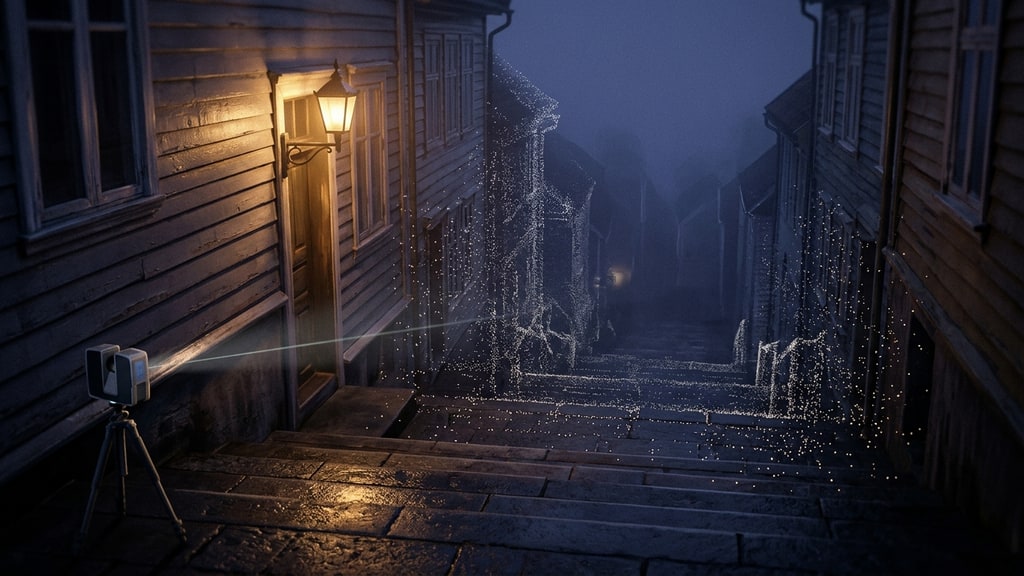
The third returns to a single street in Kyoto, the Sannenzaka slope, at night only. The same author had published a photogrammetry version about fifteen months earlier and rescanned it with 3DGS, mainly as a test of how much closer current capture gets to the real thing. The slope that is shoulder to shoulder by day is empty in there.
Nothing about that trio is generative in the sense the industry usually means. The geometry is measured, not sampled from a probability distribution. The model fills the gap a static capture leaves: drift, wind, the small physics of a place. That gap is real work, and it is the part nobody demos.
The live systems are infrastructure that happens to use AI
Then the category stops looking like an art show.
One entry is a capture rig: about sixty cameras arranged around a person, firing together, turning a human body into 3D data on site. It has scanned around four hundred people at events, and the resulting models go home with the participants. Current turnaround is roughly three minutes for a rough shape and around ten for something clean, which is the difference between a demo and a service people will queue for.
The other is tougher to file. At the Waseda-Keio football match at the National Stadium in August, roughly ten thousand spectators played a system built around two games. One grades facial expressions against a prompt. The other alternates between the two schools' supporter sections and measures who can shout louder. The stated concept was warming up the stands: players get a warm-up, so the crowd needs a run-up before it can make noise. The build used Claude Code and Codex, with MediaPipe for face tracking. A side effect nobody planned is that the game taught people the cheer songs.
Note the split of roles there. The coding agents are the tool used to make the thing. AI as an interaction layer is the thing. Those are two different claims, and the AI discourse keeps braiding them together into one.
The screen test is the honest evaluation
Awards like this one usually publish a winner list and move on. This category publishes its own limits.
Voting is one work per field, free for anyone, closing on 13 November (AoE), which lands on the evening of 14 November in Japan. To cast that vote you either visit a VRChat world or watch a video. The material is uneven by design: the three restorations have YouTube walkthroughs, the Shibuya screening piece has its own video, and the other entries are represented by images, an X hashtag, or magazine reports. The gallery text grades, entry by entry, how far each one can be followed through a screen. That is an unusual admission in a field that otherwise behaves as if a good thumbnail is a fair proxy.
For anyone who publishes spatial work, the practical reading is not "make better screenshots." It is that a place needs a route. A slow pass along the actual path a visitor would take, with the sound left in, shows more than a sweeping orbit of a point cloud. A scan with no wind and no bird noise reads as dead geometry within three seconds. The forty-second clip recorded from inside the world is not marketing; it is the only honest trailer the medium has.
What to take from ten entries that mostly refuse to be images
If you work in 3D or in virtual production, the category argues for capture as the primary skill. Reconstruction is unbeaten on fidelity per hour of work, and generative tools are best used where measurement stops: motion, weather, decay, the looseness of a real scene.
If you make images, the useful lesson is about where you put the model. In all three restorations, AI handled analysis, organization and the animation layer. The output people actually respected came from a camera and a lot of manual reassembly. That is a more durable division of labor than "prompt the whole scene and fix it later."
The last point is about scope. The category exists because the field finally produced work that cannot be posted. That is not a failure of the format. It is the first sign that AI creative output has grown something other than files.
Related reading: how one AI award started scoring the commentary instead of the pictures, and what a published scoring rubric says about where craft actually lives.