AI Demand Just Killed a Chip Line That Nintendo Still Needs
Macronix is winding down ROM production because AI data centers pay more for the same wafer capacity. Nintendo has a second supplier, so cartridges survive for now. The rest of the memory squeeze lands on the storage and GPUs your creative pipeline runs on.
AI-assisted draft. Reviewed and edited by the Phosphene team before publication.
On this page
- Why a fab drops a product that still sells
- The cartridge's real protection was a second source
- The same squeeze, three products away from your pipeline
- Three consequences that are not doom
- Hardware buying stops being a waiting game
- Per-generation prices are now a bet, not a baseline
- Physical media is turning into a premium format
- What we are not claiming
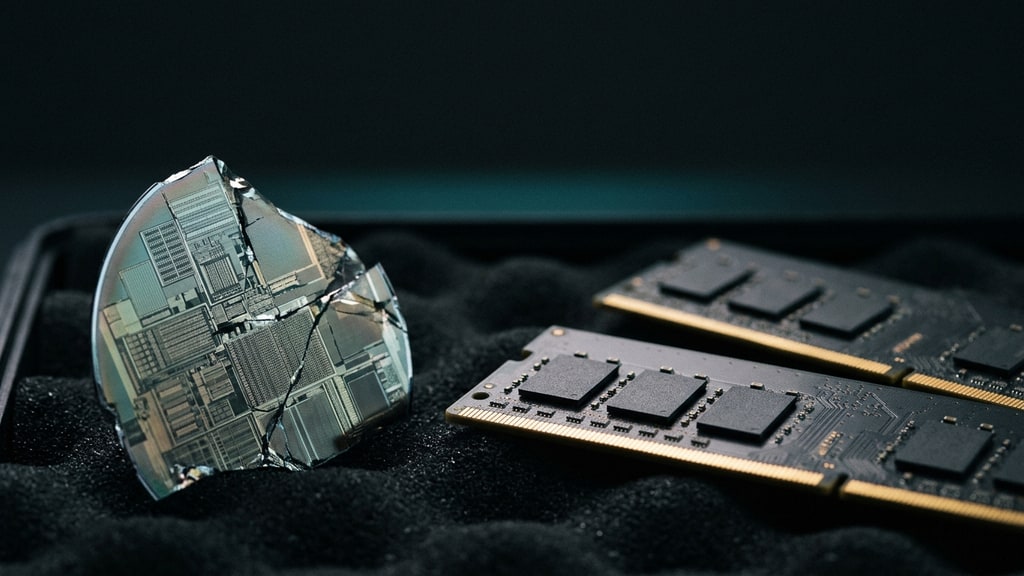
Nintendo's cartridge supply has a supplier problem, and the cause is a data center in another industry.
Macronix, the Taiwanese memory maker, reported its third-quarter 2026 numbers this week. ROM revenue fell 39% year over year. NOR flash revenue rose 158%. NAND rose 768%. All three products come off the same wafer capacity, and only two of them are being bought by AI data centers at almost any price. Macronix's response is to wind down ROM production and move that capacity into the lines that pay.
ROM is the chip that holds permanent data: firmware, boot code, industrial controllers, car modules, and game cartridges. Nintendo uses ROM in Switch and Switch 2 carts. So a shortage created by AI capital spending has reached a product category that has nothing to do with AI, in a way most people can see.
The mechanics are worth slowing down for, because they are the same mechanics that decide what your next workstation costs and whether hosted generation keeps getting cheaper.
Why a fab drops a product that still sells
Macronix is not leaving ROM because demand collapsed on its own. It is leaving because wafer capacity is finite and NOR and NAND earn more per square millimeter right now. When one product line grows by 768% and another shrinks by 39%, reallocating capacity is not a strategic bet. It is arithmetic.
There is a dramatic version of this story where Nintendo's physical format dies this quarter. That is not what the reporting says. Nintendo buys ROM from more than one company. ROHM and its Lapis Semiconductor subsidiary are named as alternative suppliers, so cartridge production continues for now. For Switch 1, Macronix's exit may reduce the number of suppliers and with it Nintendo's bargaining position. Its role in Switch 2 cartridge supply remains uncertain. Xataka frames the consequence carefully, as a hypothesis rather than a fact: fewer ROM suppliers could raise cartridge manufacturing costs, and those costs could eventually reach physical game prices.
That is where the consumer story ends. The part worth carrying into creative work starts when you follow the capacity instead.
The cartridge's real protection was a second source
Before the AI angle, there is a supply-chain lesson sitting in plain sight. Nintendo survives this because it never depended on one vendor for a component that defines its product. Cartridge ROM holds game data and can be hard to substitute on short notice. The only real defense is having another company that can make it.
Every hosted model in your pipeline is a mask ROM. It is a component you do not control, priced by a vendor whose capacity is being repriced by demand you cannot see, and it can be deprecated or reprioritized on someone else's schedule. The teams that handled this year's model churn well were not the ones with the best prompt library. They were the ones whose project could survive a model disappearing, because the shot list, the references, and the acceptance criteria lived somewhere other than one vendor's API.
How Wan 3.0 fits as a cost lane rather than a replacement is the same argument with different numbers.
The same squeeze, three products away from your pipeline
Memory makers face separate capacity constraints. AI data centers buy high-bandwidth memory and NAND for storage. HBM production competes with conventional DRAM for wafer capacity, while data-center storage demand can constrain NAND supply. Nintendo's cartridge is the visible casualty this week. The invisible ones are the parts a working pipeline runs on.
NAND flash is where footage, exports, project archives, and downloaded model weights live. DRAM is what your editing machine and your local generation box are always short of. HBM is what the GPUs behind every hosted image and video model are built around. Three products, distinct supply constraints.
Micron's numbers show the demand side. In March 2026, it reported fiscal Q2 revenue of $23.9 billion, close to three times the prior year, and guided for roughly $33.5 billion in the following quarter. In September, it reported fiscal Q4 revenue of $54.23 billion. CEO Sanjay Mehrotra said the company could cover between half and two-thirds of what its largest customers needed. In March, SK Group's chairman Chey Tae-won forecast a shortage through 2030.
The forecast spans years, which matters when planning creative tools and workstation purchases.
Three consequences that are not doom
Hardware buying stops being a waiting game
For fifteen years the sensible advice on storage and RAM was to wait. Prices fall, capacity grows, buy later. That advice assumed consumer demand set the price. It does not hold when the marginal buyer is a data center with a capex budget and a queue. If you are planning a local generation machine or a NAS for a video pipeline, the useful question is no longer "will this be cheaper in six months" but "do I need it before the next project". What local image generation actually gains from a big memory pool is worth rereading with that framing, because the spec sheet math changes when memory itself is the scarce input.
Per-generation prices are now a bet, not a baseline
Hosted image and video pricing has fallen for two years, underwritten by cheap capacity and vendor competition. Both of those inputs are under pressure. That does not mean a price jump next month. It means a cost model built on "inference gets cheaper every quarter" is now a position someone took, and the pipelines that survive a repricing are the ones that can move a shot to another model without rebuilding the project.
Physical media is turning into a premium format
A cartridge that costs more to build is a cartridge that survives for collectors, special editions, and products where the object is the point. If your work touches printed matter, packaged editions, or physical goods with electronics in them, the bill of materials you estimated last year needs a second look.
What we are not claiming
We have Macronix's own quarterly figures and the reporting around them. We do not have a consumer price series, a forecast, or a look at anyone's supply contract. The capacity reallocation is documented. The effect on the price of a 4 TB SSD next spring is inference, and anyone who hands you the exact number is guessing.
What can be said with reasonable confidence is the direction. AI demand is now large enough to change what gets manufactured, not just what gets funded. Nintendo's cartridge is the first casualty most people will notice. It will not be the last, and the ones that follow sit closer to the work.