The Fashion Photo Studio Closed. The AI Replacement Beat the Studio Images.
Zalando shut both Berlin studios. About You moved roughly 90% of its ecommerce production to generated imagery, cut costs by about 90%, and then found the AI shots produced 9.2% more GMV than studio shots. The cost saving is the smaller story.
AI-assisted draft. Reviewed and edited by the Phosphene team before publication.
On this page
Two numbers from the same week describe the same business.
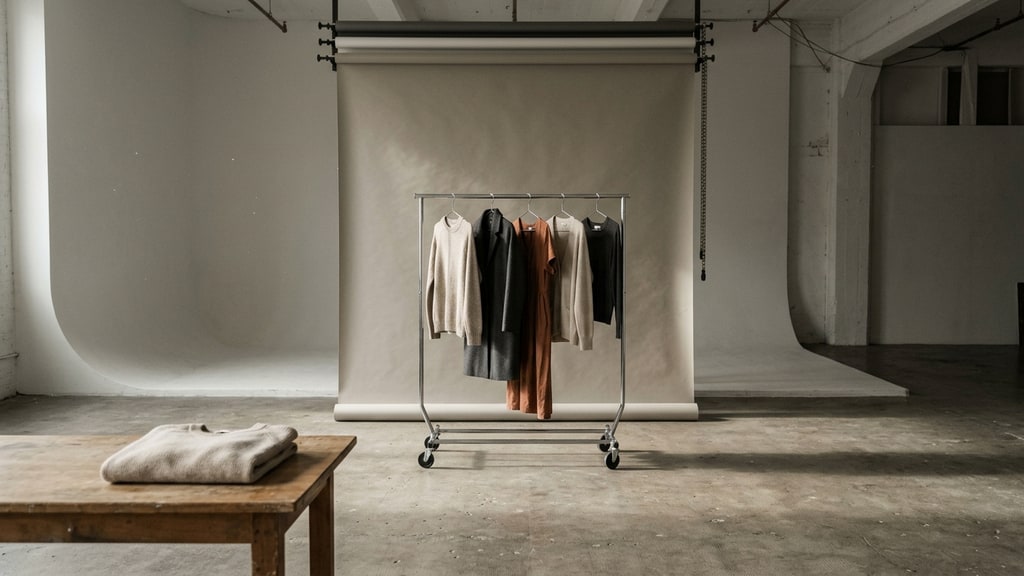
Zalando closed both of its photo studios in Berlin, and 340 jobs went with them. About You, a Hamburg retailer from the same market, said its AI studio generated more than 80,000 outfits in the previous 30 days and that roughly 90% of its ecommerce production now runs through AI-based workflows.
This is not a forecast anymore. It is a line in a corporate press release.
What About You actually published
The company's July press release reads like a product launch, and buried in it are the numbers that matter more than the marketing does.
- About 90% lower production costs, and more than 95% faster time to market.
- More than €8 million a year saved on studio and editorial costs.
- A/B test result: generated images produced a 9.2% GMV uplift and 5.1% more add-to-basket than classic studio images.
- In a "multi-set routing" setup, where several generated sets run against a studio set per product, the uplift reached up to 20%.
- Scayle Studios is sold as SaaS with more than 100 pay-as-you-go brands plus enterprise customers like s.Oliver, Betty Barclay and Goldner Fashion. It passed €1 million in annual recurring revenue 2.5 months after launch.
The cost figures are what everyone quotes. They are also the least interesting part, because a 90% cost reduction is a margin event. A competitor can match it, and then all you have is a cheaper way to make the same picture.
The conversion number is a different kind of claim. It says the generated image was not just cheaper than the studio image. It sold better.
Why an AI set could outsell a photograph
A photo studio produces one canonical image of a product, then variations of it. Front, back, detail, angle. The whole apparatus, the lighting, the model, the stylist, the retoucher, exists to make that one image true: this is the fabric, this is the drape, this is the colour, this is how it sits on a body.
Every additional version costs money in a way that scales with people and time. A new location is a new permit. A new model is a new casting. A new market is a new shoot day, or it is the same shoot day with a different post-processing pass and a hope.
Generating the set inverts the cost curve. The marginal version is close to free, so the question stops being "how many images can we afford" and becomes "how many should we test". That is the actual change About You is reporting: their test compares several generated sets against the studio set per product, per market, and the images that win are chosen by sale rather than by taste.
Commerce never wanted one true picture. It wanted the picture that converts in each placement and each country. The studio was a bottleneck that made that question unaffordable to ask, which is why for twenty years nobody asked it.
The part that does not go away
There is a reason ecommerce did not simply replace photography in 2023, when the first wave of product-image tools arrived. Generated images are a rendering of an intention. A photograph is a record of an object.
That difference does not matter much for a campaign image whose job is to evoke a mood. It matters a great deal for the shopper trying to decide whether a jacket will fit, whether a knit will pill, whether the colour in the photo is the colour in the box. Those are questions about a specific physical object, and only a capture of that object answers them.
The place this becomes expensive is returns. A generated image that flatters a garment moves the purchase decision earlier and the disappointment later, and the cost lands on reverse logistics rather than on the photo budget. None of the published About You numbers measure that, and no press release would.
So the honest split is not "AI or studio". It is: capture the object where accuracy is the product, and generate the variations where the object is already established. Fit, texture and colour need a real reference. The fourth background, the seasonal restyle, the market-specific model, the social crop, and the forty variants for a paid test do not.
The cost moved onto the person in the picture
Reuters reviewed confidential shoot contracts from brands including Calvin Klein, Diesel and L'Oréal, and the clauses are the part of this shift that will be litigated.
One draft Calvin Klein contract allowed the brand to use "reasonably unrecognizable images of Model" to train and fine-tune AI tools, with no extra payment. A Diesel casting sheet asked models to accept "alteration or reconstruction of facial features and body proportions", the swapping of faces among participating models, and the superimposition of a participant's face onto another person's body. Diesel told Reuters the release covered one campaign and was not a typical contract. Reale Actives, a brand that also sought digital clone rights, denied ever using AI to replicate a model.
Read those clauses as a sign of where the money moves. The 90% saving has to come from somewhere, and part of it is the recurring cost of the person who used to stand in the light: the studio day, the crew, the usage fee. When a studio closes, the invoice stops. When a likeness gets folded into a standard release, the invoice stops but the face keeps working.
The contracts do not quantify any of that, and About You's figures cover its own studio and editorial budget, not the model fees of the brands Reuters reviewed. Treat the connection as an inference rather than a measured share. What the documents do establish is that the reduction in cost is being negotiated on the side of the person in the picture, in contracts that rarely mention AI by name.
That is the same pattern already visible in microdrama production, where studios remake shows with AI versions of the actors they hired. The economics are identical: the cheapest asset is the one you have already paid for once and can reuse under a clause nobody negotiated.
What this means if you sell image production
The studios that closed were selling capacity: days, crew, space, retouching hours. Capacity is exactly what got cheaper.
What is still scarce is the judgement about which picture a market will buy, and the discipline to prove it. If you produce product imagery for a living, the sellable unit has changed shape. It is no longer a shoot. It is a variant plan: how many sets per SKU, for which channels, with a stated test protocol and a rule for which set stays. That is a document a brand can be billed for, and it is a document a model cannot generate.
Three practical rules from the way this is already running in production:
Keep a truth pass. One capture per SKU where accuracy is the requirement, at the resolution a shopper can zoom into. Everything downstream can be generated from it.
Write the channel spec before the prompt. Aspect ratios, safe areas, background policy, model diversity per market, and the file sizes each placement needs. The same commoditization logic that hit video budgets applies here: when the asset is cheap, the specification is what you are paid for.
Measure the picture, not the shoot. The only number in this story that survives a competitor copying the technique is the 9.2%. If you cannot show which image sold better, you are selling labour again.
The irony in the same week
Canon told investors it no longer expects memory prices to fall in 2027, and that its policy is to offset higher component costs through camera price increases. Fujifilm has warned about the same pressure, and Blackmagic has already raised prices on some cinema cameras and storage, citing memory. The hardware got more expensive in the same quarter that the labour behind the hardware became optional.
None of this means photography is finished. LIFE is relaunching as a digital platform, and the Urban Photo Awards just handed out prizes for work that exists because a person was standing in the right place when something happened. Both are bets that a recording of reality is worth more as generated images become indistinguishable from it.
The fashion industry did not make that bet. It ran an A/B test, and the machine won on gross merchandise value, not just on cost. That is a much harder fact to argue with than a demo reel, and it is the one everyone in commercial image-making should be reading this week.
Sources
- Foto-News: KI verdrängt Fotostudios, Canon warnt vor Preisanstieg – News der Woche 44/2026 (German original, where the Reuters reporting surfaced)
- Photo Studios Are Closing as the Fashion Industry Embraces Generative AI (PetaPixel, summarizing Reuters)
- In Minuten statt Wochen: ABOUT YOU Group launcht mit SCAYLE STUDIOS ein AI-basiertes Fotostudio (company press release, 20 July 2026)
- Canon Q3 2026 earnings Q&A, on memory component costs and 2027 pricing
- Canon says camera prices could rise in 2027 if memory costs stay high (DPReview, reading the same Q3 Q&A)