A 27B Model on a Gaming GPU: Qwen 3.8 Shows Local AI Stopped Being a Compromise
Alibaba shipped Qwen3.8-27B open weights and the self-hosting community responded with a countdown page. A hands-on German test shows what actually runs on 16-24GB consumer cards: the VRAM ladder, quantization reality, and where the gap to frontier models really stands.
AI-assisted draft. Reviewed and edited by the Phosphene team before publication.
On this page
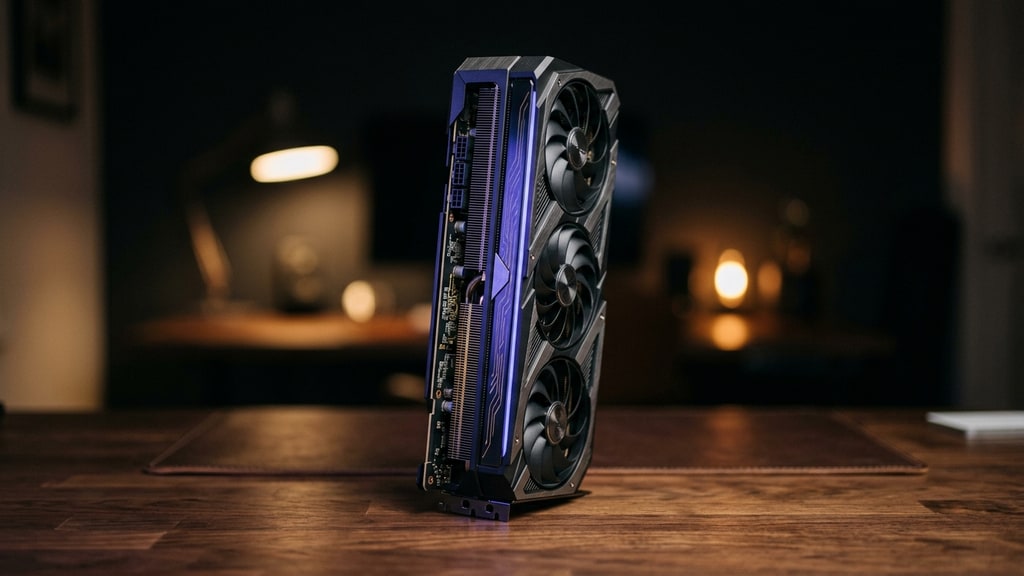
When Alibaba announced that the open weights for Qwen3.8 would land "next week," the self-hosting community started refreshing Hugging Face. The anticipation was strong enough that the model platform put up a countdown page. The model people were waiting for was not the flagship Qwen3.8-Max with its 2.4 trillion parameters. It was the 27B version, the one small enough to fit on a graphics card a normal person can buy.
heise online, the German tech outlet, ran the model on consumer hardware the same weekend the weights dropped and wrote up what actually happens. The results are worth reading slowly, because they change the question creators ask about local AI. It is no longer "can I even run this?" It is "what exactly am I giving up, and is it less than I thought?"
The VRAM ladder
The official Qwen3.8-27B checkpoint is 28B parameters in BF16, which puts its raw weight footprint at roughly 56GB before runtime overhead. In 32-bit floating point it would be a hypothetical ~108GB, and realistically about 120GB once you add the key-value cache. That is datacenter territory. But quantized versions change the picture fast, and the exact fit depends on context length, backend, and KV-cache size:
- FP16 needs roughly 56-64GB of VRAM (weights alone sit around 56GB).
- The Q5_K_M quantization fits in about 22GB. That covers high-end gaming cards like the AMD Radeon 7900 XTX and the RTX 3090, 4090, and 5090.
- Unsloth's NVFP4 variant, optimized for Nvidia's Blackwell compute units, runs in 16GB of VRAM on a short context.
The rule of thumb for local inference: a model performs best when it fits entirely in the video memory of your GPU. If it spills into system RAM, partial offload can run noticeably slower, though it is not automatically unusable. So the practical ceiling for consumer hardware right now is a 27B-class model with aggressive quantization, or something bigger if you have a workstation card.
Quantization is not the sacrifice it used to be
heise tested two variants on Nvidia hardware with llama.cpp: Q8_0 and NVFP4. The NVFP4 model used roughly half the VRAM of Q8_0, and the testers could not feel any meaningful loss in quality or accuracy. That is the quietly important result. A few years ago, aggressive quantization meant noticeably dumber output. At this size and with these formats, the gap has shrunk to the point where the practical bottleneck is your VRAM budget, not the quality loss from compression.
This matters for creative workflows in a direct way. The same logic applies to open-weights image models: quantization tiers decide which generation models fit on your card, and the old assumption that "quantized means visibly worse" no longer holds for the current generation of formats.
The hands-on test
The heise team gave Qwen3.8-27B the kind of task it is supposed to be good at: build a complete REST API for an inventory management system with user management and role-based permissions, without asking clarifying questions. Two observations stand out.
First, the model was remarkably thorough. The code compiled on the first attempt, all requested functions were present, and the model handled edge cases that were never mentioned in the prompt. It even found duplicates in its own code during the run and refactored them on its own. The testers said the output was indistinguishable from what they would expect from Claude on the same task.
Second, the failure mode is the opposite of sloppiness. The model tends to overthink simple problems, burn tokens on unnecessary detail, and take longer than needed. The full task took about 12 minutes in Q8_0. That behavior can be tuned with parameters, but it is the tradeoff to know about: this model errs on the side of thoroughness, not carelessness.
The vendor benchmarks report Qwen3.8-27B beating its predecessors and Meta's Muse Glimmer 30B, with a mixed picture against Anthropic's Opus 4.6 Max: below it on Terminal Bench 2.1 and NL2Repo-Bench, but ahead on SWE-bench Pro. Vendor numbers always deserve skepticism, and one qualitative REST API run cannot validate frontier parity. Still, the independent test at least confirms the direction: for a model you can run on a gaming GPU, the distance to the frontier has become surprisingly small.
Why this matters to creators
Local models have three concrete advantages for creative work, and none of them are about benchmark scores.
Privacy. Every prompt you run locally can stay on your machine when the serving stack has no telemetry, remote tools, plugins, crash reporting, or network egress that you have not controlled or disabled. For concept art, client work, or unreleased product designs, that removes the "someone else sees the prompt and the output" concern entirely.
Cost control. A card you already own replaces per-generation API fees. The economics flip from "each image costs something" to "the hardware is the only bill."
Offline reliability. No provider rate limits, no provider outages, no queue. Availability still depends on your host, GPU, drivers, server process, model loading, and local throughput, but a working local setup is there at 3am exactly when you need it.
The honest limits matter too. Qwen3.8-27B is a text and code model with image and video understanding, not an image generator, and local image generation at frontier quality still has its own gaps. But the pattern is visible: open weights, then quantization, then consumer VRAM. That is the same trajectory image models have been riding, and every step down that ladder makes self-hosting more practical.
One more thing worth knowing, mostly for teams that handle security: abliterated variants of Qwen3.8-27B appeared on Hugging Face within days of release. These are versions with the model's guardrails largely removed. An abliterated model cannot scan or exploit systems by itself: practical risk requires the model to have tool access, network access, and an authorized target. The heise piece flags the obvious consequence: models that can hunt for vulnerabilities are no longer limited to a handful of hand-picked ethical hackers. If your work touches security-sensitive infrastructure, run such models in a sandbox, restrict egress, and apply least-privilege permissions so that threat model stays precise.
The practical takeaway
The barrier to entry for capable local AI is now mostly a hardware question. Check your VRAM, pick the quantization tier that fits, and the experience is closer to a frontier model than most people expect. Unsloth's new desktop app, aimed at first-time self-hosters, is another sign that the ecosystem is moving past the command-line-only phase.
Local AI stopped being a compromise. It is now a legitimate third option next to free tiers and subscriptions, with a different set of tradeoffs. For creators who value privacy and fixed costs, that is a meaningful change.