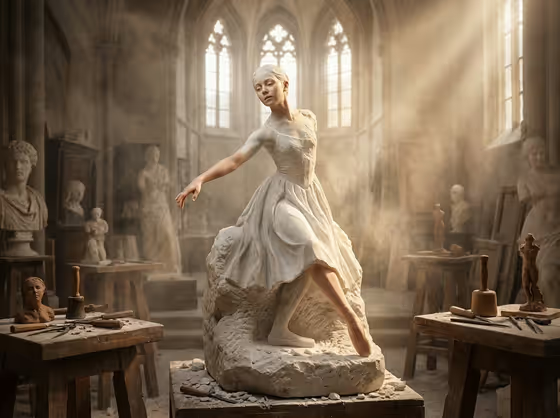
Awakening from Marble makes a 3:4 image of a half-carved marble figure caught in the moment it comes to life. The scene is set in a dusty Renaissance-style workshop: raw stone stays attached at the base, chisel marks run through the middle, and the most refined parts, like hands and face, look alive.
It suits people who want a dramatic, painterly portrait-style image for art posters, story illustrations, album or book covers, or just a striking piece of sculpture fantasy. You describe the subject and the kind of transformation, and the template handles the workshop, light and dust.
What works best as input
- The first field, Sculpture Product Subject, accepts either a written description or an exact visual reference photo. Use a photo only when you want the sculpture to follow a specific look, and make sure you have the right to use it.
- If you add a photo, pick one where the subject is clearly visible and well lit, so the carved figure has a readable pose and outline to build from.
- If you type instead, be concrete about who or what the sculpture is and what it is doing, for example a dancer forming from raw limestone or a musician awakening from stone.
- Keep the subject to one figure. The template is built around a single sculpture emerging from stone, so extra subjects can compete with the main idea.
How to use it
- Open the Awakening from Marble template in Phosphene.
- In Sculpture Product Subject, describe the figure you want or add a visual reference, then check the placeholder and examples for the level of detail that works.
- In Living Transition, describe where the stone turns lifelike, such as rough base to lifelike hands and face, or chisel marks becoming skin at the shoulders. This field is text only.
- Generate the image, then review it. Check that the raw stone sits at the base, tool marks show in the middle, and the lifelike detail is concentrated where you asked.
Tips for a better result
- Be specific in Living Transition about which body part wakes up first, like fingertips, shoulders or eyes. A clear location gives the image a focal point.
- Try the example subjects as a starting point and then swap one detail, such as a mythic winged guardian instead of a human figure, to get a very different silhouette.
- Pair a subject with a transition that makes physical sense, for example a musician with lifelike hands, so the awakening feels natural rather than random.
- Run the template a few times with small wording changes and compare, since the dust, light beams and carved fragments will vary the mood each time.
Common mistakes
- Writing a vague subject like just a statue. Without a pose, role or material hint, the figure tends to feel generic.
- Asking for the whole sculpture to be fully alive. The template is about a transition, so describe a gradient from stone to life rather than a finished human.
- Putting several figures or lots of unrelated scene details into one field, which can crowd the composition and blur the focus on the single awakening sculpture.
FAQ
Do I have to upload a photo?
No. Sculpture Product Subject accepts a text description or a visual reference, so you can simply type what you want. Living Transition is text only.
What size is the result?
The template outputs a still image in a 3:4 aspect ratio.
What should I write in Living Transition?
Describe where and how the stone becomes lifelike, for example chisel marks becoming skin at the shoulders or an unfinished block resolving into conscious eyes.
Will the whole figure look human?
The template is designed so raw stone stays at the base while the most advanced features, like hands and face, appear subtly alive. Your wording in Living Transition decides where that shift happens.