Limited Animation Is the Missing Skill in AI Anime Production
A Japanese AI anime studio rebuilt limited animation techniques for AI production: Kling 3.0 for prototyping, older models for cost control, and a production split that treats the anime as a sub-project. What works and why.
AI-assisted draft. Reviewed and edited by the Phosphene team before publication.
On this page
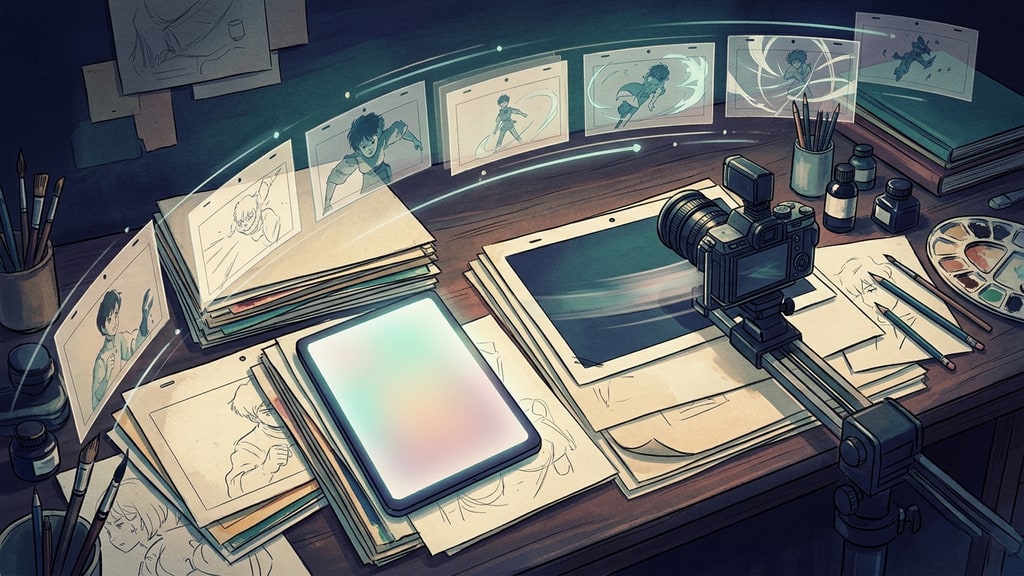
Most people trying to make AI anime fail at the same point. They generate clips, stitch them together, and end up with something that looks like a slideshow of pretty frames rather than a film.
The missing piece is usually not a better model. It is a production technique older than AI itself: limited animation.
In June 2026, the Japanese AI production group CreativeEdge CL+ ran a live session on exactly this topic, covering the history of limited animation, how to redefine it for AI workflows, Kling 3.0 prototyping, and aggressive cost cutting by reusing older models. The session was recorded for their MicroEpic Club archive, which requires a ¥500/month membership to watch. Here is what the approach looks like in practice, and why it works.
What limited animation actually is
Limited animation is the discipline of not animating everything. It was invented in the 1950s and 1960s at studios like UPA and Toei, then perfected by Japanese TV anime: hold a character cell still while the camera pans, animate only the mouth, reuse a walking cycle, change the background instead of the drawing. The audience's brain fills in the motion that is not there.
That was a cost decision first and an aesthetic decision second. Full animation is expensive. Limited animation made weekly TV episodes possible.
Here is the part that matters for AI creators: limited animation is a catalog of concrete production moves, not a vague style. Holds. Reuse. Camera moves over static art. Selective motion. These are the exact moves that video generation models are good at producing reliably, and the exact moves that make a project finish on budget.
Why AI anime needs limited animation more than full animation
Full animation asks a video model to do the hardest thing it can do: keep a character perfectly consistent across dozens of rapidly changing drawings. That is where models break. Faces drift, clothing redesigns itself, the second character morphs into furniture.
Limited animation inverts the problem. Instead of demanding constant regeneration, you ask the model for fewer, longer, more stable segments and let editing carry the rest.
A practical split:
- Static plates and holds. Generate a strong key visual, then use slow camera moves or subtle parallax instead of asking for new motion. A model can hold a background steady far more reliably than it can animate a fight.
- Selective motion. Animate the mouth, the hair, one hand. Leave the rest of the frame alone. Models handle small, contained motion far better than full-body choreography.
- Reuse as a feature, not a failure. If you build reusable clips and loops, the second episode is cheaper than the first. The session's framing treats reusability as the core of the pipeline, not as cutting corners.
The result is a production that reads as "anime" in the way the medium actually works, instead of chasing a full-animation ideal that will bankrupt your iteration budget.
Kling 3.0 as a prototyping lane
A notable detail from the session was using Kling 3.0 for prototyping. The point was not that Kling 3.0 is the best final-quality model. It was that a fast, responsive model is the right tool for the early production stages where you are still figuring out what the scene is.
Prototyping with a fast model changes the economics of exploration:
- test timing and pacing before committing to expensive renders
- block out a scene and check whether the beat works
- validate character motion in rough form
- hand the editor something watchable while the hero shots render
This is the same two-lane thinking that works in image generation: draft model for decisions, premium model for final art. In video it matters even more, because every failed full-quality render costs minutes or credits instead of seconds.
Cut costs with older models instead of chasing the newest
The most contrarian takeaway was deliberate: use old models to cut costs significantly.
The industry conversation around AI video is dominated by "the newest model just dropped." CreativeEdge's session pushed the opposite direction for production work: the previous generation of models is usually good enough for large parts of a project, and dramatically cheaper to run.
A cost-conscious lane split looks like this:
| Material type | What it needs | Which lane |
|---|---|---|
| hero emotional scenes | face consistency, expression depth | newest model |
| dialogue and coverage | stable composition, reuse | older model |
| B-roll, transitions, inserts | reliability over novelty | older model |
| rough motion tests | speed, cheap iteration | prototype model |
The uncomfortable truth is that most shots in a finished piece do not need the absolute newest generation. The audience notices the emotional close-up, not the five-second transition. Spending the newest-model budget only where it is visible is how a project stays alive.
Treat the anime as a sub-project
The last structural decision is also the easiest to copy: run the anime as a sub-project, not as the main production.
For CreativeEdge, the main project is "COLORS," a live-action-style AI drama. The anime is a parallel lane. That framing protects the anime from becoming a money pit. It gets a bounded scope, a bounded budget, and a defined finish line, while the studio keeps its main production running on a different track.
If you are a solo creator, the version of this is simple: do not start with a feature-length anime. Start with a short, a teaser, or even a single scene that demonstrates the technique. Define the budget in generations and hours before you start, and treat everything beyond that as scope creep.
A workflow you can steal
Pulling the session's ideas together into something runnable:
- Write a beat sheet, not a script. Decide which beats need real motion and which can be holds, pans, or reuse.
- Prototype in a fast model. Block the scene, check timing, find the shots that actually work.
- Route shots to lanes. Newest model for hero moments, older model for everything that can survive it.
- Build a reuse bin. Store loops, plates, and transitions as labeled assets. The second production should pull from the bin, not regenerate everything.
- Finish. Cut, mix, publish. A complete short beats an infinite draft of a feature.
The philosophy underneath it is simple: treat the model like an animation department with limited hours, and plan like a studio that has to ship. Limited animation was invented because the budget was real. The same discipline applies when the budget is VRAM and generation credits.
That is not a compromise. It is how the medium has worked for seventy years, and it translates directly to AI.