MiniMax H3 for AI Anime: Matching Seedance 2.5 at a Quarter of the Cost
A Japanese AI filmmaker reran his video test in the anime lane: same character reference, same prompt, 16 seconds. MiniMax H3 kept up with Seedance 2.5 while costing a fraction of the credits. The reason changes how you should rank models.
AI-assisted draft. Reviewed and edited by the Phosphene team before publication.
On this page
A week ago the verdict on MiniMax H3 looked settled. In a live-action drama test, Seedance 2.5 ran away from it and the best role H3 could get was B-roll. Same author, same channel, one week later: the ranking flips.
The follow-up test from CreativeEdge CL+ puts H3 against Seedance 2.5 in anime, and the result contradicts the previous article's expectations. For cel animation, H3 roughly matches Seedance 2.5 while burning a quarter of the credits. The reason is not that H3 suddenly got better. It is that anime and live action ask very different things from a model.
Same reference, same prompt, different result
The test reused the exact setup from the author's Seedance 2.0 workflow: the same character reference image and the same simple two-beat prompt. A girl mutters "what should I do" with her arms crossed, then smacks her fist into her palm, brightens, and announces she has an idea. She claps, shouts "let's go to the sea," skips off, then suddenly runs while the camera tracks her from the side.
Two generations at 2K, sixteen seconds each. The verdict: "pretty good, same level as Seedance 2.5." The author skipped the basic checks because public H3 anime examples already looked clean, and went straight to a production-style pass.
Why a weaker simulator can look equal in anime
This is the part worth stealing. In the drama test, H3 lost because it flattened faces. The mid and micro layers of realism, eyelids, nasolabial folds, pores, skin texture, came out too smooth. More CG than actor.
None of those layers exist in cel anime. An anime frame is outlines, shapes, flat color fields, and a character's visual identity: hairstyle, silhouette, palette. Photoreal micro-detail is not part of the target image, so the failure mode that sank H3 in live action disappears.
What remains is the hard part: can the model hold the character stable while things move fast? In the anime test, H3 could. The author lists what stayed stable:
- outlines hold under fast motion, where Kling 3.0 visibly collapsed
- the face holds
- the hairstyle holds
- the color palette does not drift
- cel shadows stay put
- poses change correctly
- the character keeps its position relative to the background
That list works as an anime-specific test battery on its own. Run any candidate model against those seven points before trusting it with an animation shot.
The cost column closes the argument
Animation is a volume game. A finished short is not one generation, it is dozens or hundreds of short clips, so per-clip price matters more than it does for a demo video.
Using Higgsfield list credits for 15-second clips, as of 2026-08-18:
| Model | Resolution | Credits (list) |
|---|---|---|
| MiniMax H3 | 2K (2560 x 1440) | 60 |
| Seedance 2.0 | 1080p | 180 |
| Seedance 2.0 | 720p | 90 |
| Seedance 2.5 | 1080p | 240 |
| Seedance 2.5 | 720p | 105 |
On list pricing, H3 costs a quarter of Seedance 2.5 at 1080p and about a third of Seedance 2.0 at 1080p. Two caveats: H3 only offers a 2K tier, there is no cheaper 720p option, and these are credit rates at one aggregator on one day, so the exact numbers shift with launch promotions — which also means the ratios tighten under a sale. The ordering probably will not.
The author notes that most aggregators are running H3 launch promotions, with Magnific at 50% off as of the publish date. If you want to test the anime lane cheaply, the window is right now.
Motion graphics: the near-tie
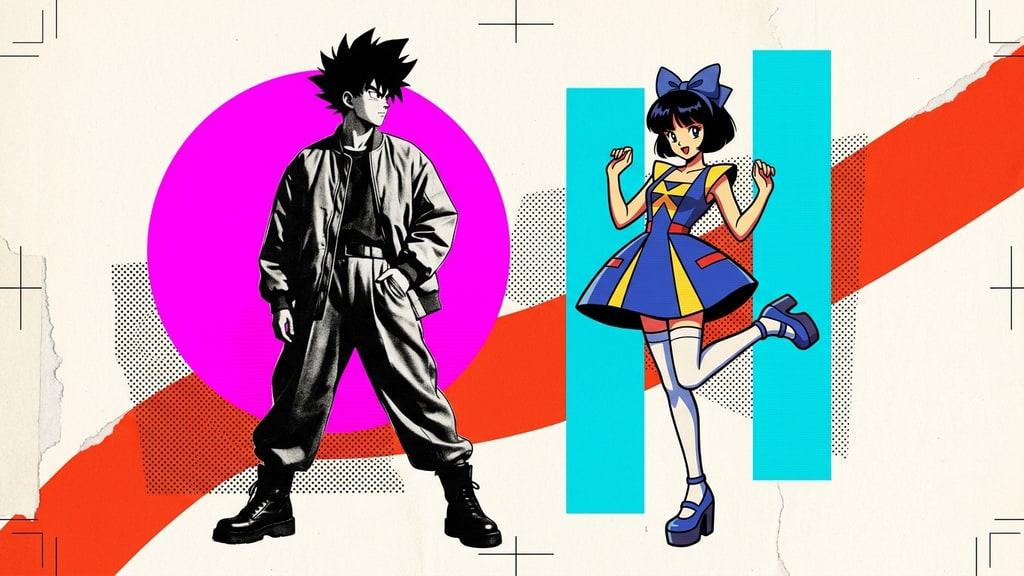
The second test was harder: a 37-second MV-style motion graphics clip with two manga-style characters and a fast, rhythmic edit. This is where the source shows its prompt discipline, and the technique transfers anywhere:
- character references are tagged in the prompt as @img1 and @img2 so both characters stay distinct
- the visual style is declared as a system: 1980s-90s postmodern editorial photomontage, off-white paper background, one fluorescent magenta circle, one cyan rectangle, one vermilion diagonal band, halftone dots, scan lines, torn collage masks
- readable text is whitelisted: exactly two phrases are allowed, everything else must stay abstract
- the shot plan is time-coded: 0-2 seconds intro, 2-4 first pose, 4-6 swish pan, and so on, with camera moves and graphic transitions assigned per segment
That structure — style stack, reference tags, text whitelist, time code — is a reusable template for any character-heavy motion graphics prompt. One note: @img1 and @img2 are provider-specific reference tokens, not a universal standard. They work in the tool this source used; if you switch providers, check how your target tool references uploaded images and adapt that notation while keeping the template's broader structure.
The result: for live-action, Seedance 2.5 is still clearly ahead. For anime-style graphics, the gap nearly closes. Seedance 2.5 has higher raw visual quality, but the overall rating lands close. That is the pattern to remember: model rankings are style-relative. Test in the style you actually produce, not the style the demo videos use.
Local weights change the economics, not the rules
The source's bigger point is about how you buy compute. Using a model through an API is renting equipment. Every generation depends on the provider's pricing, terms, moderation, concurrency limits, outages, model updates, retirements, and price changes. MiniMax released H3-Base weights that can run locally, which moves you from renting a studio by the hour to owning the cameras.
Renting is the right call for a few dozen clips. Owning starts to matter when the plan is thousands of shots over months. The author's advice is aimed at startups entering AI anime: set up a local environment and start research now, because the research lead compounds. Individuals should think twice before buying a high-end rig, generation technology moves fast enough that the hardware can be obsolete before it pays for itself.
One thing the local path does not remove is compliance. The community license allows commercial use, but under conditions: annual revenue above $20 million requires written permission from MiniMax; commercial products must display "MiniMax H3" prominently; outputs cannot be used to improve other AI models; Hong Kong law governs; and MiniMax explicitly takes no obligation to support, update, or ship future versions. The open-weight terms are also territorial — the Community License excludes the European Union, the United Kingdom, the Republic of Korea, and the United States, and generally prohibits using H3 Works or Outputs outside the Applicable Territory. Those open-weight restrictions are distinct from hosted/API terms, which follow your provider's agreement. Permanence is conditional on staying compliant; local weights are not a license escape hatch, they are a different cost structure under the same rules.
Update the model map
The previous H3 test suggested treating video models like crew members and assigning shots by risk. This test sharpens that map for anime:
- H3 for action cuts, cutaways, stylized scenes, and most animation shots where outline stability and character identity matter more than world physics
- Seedance 2.5 for shots that need real-world grounding, complex interaction, or live-action-style continuity
- test in the target style before committing a model to a lane
The general lesson is bigger than H3: a model's ranking depends on the output domain. The same model that loses in live-action can hold its own in anime, because the audience reads different signals. Run per-style tests, keep a per-style model map, and let the cost column decide which lane each model owns.