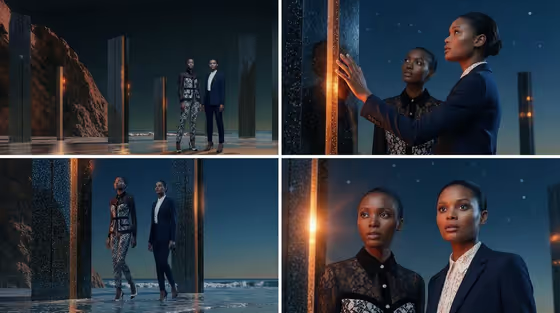
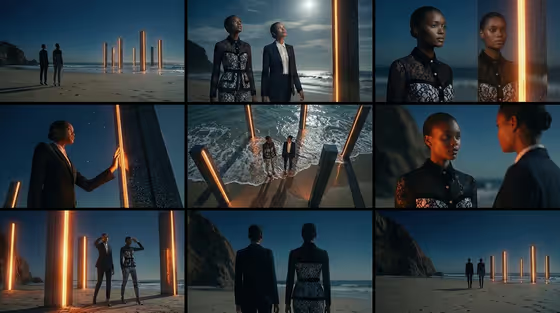
MiniMax H3 Is a B-Roll Model, Not a Seedance Replacement
A Japanese AI filmmaker compared MiniMax H3 against Seedance 2.0 for drama production. The useful lesson is not which model wins. It is how to triage video models by shot type.
AI-assisted draft. Reviewed and edited by the Phosphene team before publication.
On this page
A new video model does not need to beat the market leader to be useful.
That is the practical takeaway from a Japanese test by CreativeEdge CL+, who compared MiniMax H3 with Seedance 2.0 for AI drama production. The verdict was blunt: H3 is not strong enough for live-action drama scenes where faces, contact, emotion, and background stability all matter at once. Seedance 2.0 still handled the main character work better in that test.
But the interesting part is not the scoreboard. It is the production split hiding underneath it.
If a model cannot carry the emotional close-up, that does not mean it belongs in the trash. It may still be good for establishing shots, object inserts, stylized anime cuts, mood footage, or cost-controlled secondary material. In other words: treat video models like crew members with different jobs, not like one magic camera.
The wrong question is "which model is best?"
Most model comparisons are too vague to help a working creator. They ask which model looks better, then show a handful of cherry-picked clips. That is fine for hype, but useless when you are trying to finish a scene.
A better question is:
Which shots can this model safely own, and which shots should it never touch?
CreativeEdge's comparison is useful because it frames H3 through the needs of an AI drama. Drama is a brutal test. It does not only need pretty motion. It needs bodies to feel grounded, faces to carry small emotional changes, clothing to respond naturally, and backgrounds to stay stable while characters cross in front of each other.
That combination breaks a lot of video models.
The source test used a 20-second comparison clip with the same prompt. Because no dialogue language was specified, H3 spoke English while Seedance 2.0 spoke Japanese. That detail is small, but it says something important: production prompts need to control language, dialogue, shot duration, camera motion, and character behavior. If one of those is left open, the model will fill it in its own way.
Where H3 struggled
CreativeEdge's main criticism was that H3 did not hold up for live-action drama scenes with complex human interaction.
The first weak point was physical contact. In fight-like motion, punches and kicks lacked weight at the moment of contact. The bodies did not always feel planted. The image could look detailed, but the action felt a little detached from gravity.
That matters because viewers read contact instantly. A bad hand, a weak foot plant, or a floating body can ruin a shot even if every frame is high resolution.
The second weak point was spatial stability. The source notes background distortion during intense movement. This is one of the classic failures in AI video: the model treats the scene as a moving painting rather than a fixed set. A wall bends. Street geometry shifts. A background object breathes when it should stay locked.
For a dream sequence, maybe that is fine. For grounded drama, it breaks the illusion.
The third weak point was facial depth. CreativeEdge breaks the face into three layers: large forms such as the nose, forehead, cheeks, and jaw; mid-level details such as eyelids, nasolabial folds, and cheek volume; and micro detail such as pores, beard texture, wrinkles, color variation, and small reflections.
H3 produced the broad face structure, but the second and third layers were weaker than Seedance 2.0 in the test. The result was a face that could be clean and readable, but too smooth. More CG than actor.
That is not a small flaw for drama. If the model flattens a face, it also flattens performance.
Where H3 still looked useful
The test was not a full rejection. CreativeEdge placed H3 above Kling 3.0 for intense action stability, while still below Seedance 2.0 and Seedance 2.5 overall. The exact ranking is one creator's judgment, but the production implication is clear: H3 may be useful when the shot does not depend on subtle live-action acting.
The strongest fit is B-roll.
Use H3 for:
- city streets and atmosphere shots
- room inserts and objects
- landscapes without important faces
- transitional movement
- abstract or horror texture
- stylized anime shots where skin microdetail matters less
- shots where the subject is secondary to motion or mood
Do not give it the scene where a character has to sell grief, fear, hesitation, or romantic tension in a close-up. At least not if the visual target is live-action realism.
That may sound like a compromise, but it is how production works. Not every shot deserves the most expensive or most reliable model. If one tool gives you cheaper, acceptable secondary footage, save the stronger model for shots where the audience will notice failure.
Build a model map before you generate the film
The useful workflow is to create a model map before production starts.
Make a table like this:
| Shot type | Visual risk | Preferred model | Backup model | Acceptance test |
|---|---|---|---|---|
| emotional close-up | face depth, eye focus, subtle expression | Seedance-class model | none unless tested | same face, believable skin, no dead eyes |
| two-person action | contact, occlusion, background stability | Seedance-class model | H3 only for stylized cuts | bodies feel grounded, no bending set |
| city B-roll | structure, camera motion, atmosphere | H3 | cheaper model | no warped architecture, usable mood |
| object insert | texture, lighting, continuity | H3 | image-to-video fallback | object identity stays stable |
| anime cutaway | character silhouette, timing | H3 or anime-tuned model | Seedance-class model | style holds, face does not drift |
This is less exciting than saying "new model destroys old model." It is also much more useful.
A model map gives you a production rule before you are tired, over budget, and trying to rescue a broken scene at 2 a.m. You decide in advance which model gets which class of shot. You also define the failure condition before the output seduces you with motion.
Test models by shot families, not demos
A proper video model test should not be one prompt. It should be a small battery of production prompts.
For AI drama, test at least five shot families:
- close-up emotional performance
- two characters crossing or interacting
- fast motion with contact
- static B-roll with camera movement
- object or environment insert
Keep the character reference and prompt language as consistent as possible. Then judge each output against the job it would actually do in an edit.
Do not ask "is this clip impressive?" Ask:
- could this shot survive next to the stronger model?
- would the viewer notice the face flattening?
- does the set stay fixed when the camera moves?
- does the action have weight?
- does the model invent dialogue language, props, or gestures?
- can this be cut around, or does it poison the scene?
That last question is the real one. Some flaws are harmless in B-roll and fatal in a close-up.
Self-hosting changes cost, not discipline
The source also points to the bigger reason H3 matters: MiniMax released H3 in a form that can be self-hosted under its community license. For creators who are used to API limits and per-generation pricing, that is a serious shift.
But self-hosting does not make generation free. It moves the cost from API credits to GPU time, electricity, cooling, maintenance, queue management, and failed attempts. If the model needs five retries to produce one usable shot, that is still production cost. It just appears in a different column.
This matters for planning. A local or self-hosted model can be great for batch-generating B-roll overnight, testing variations, or producing rough motion references without paying per clip. But if the output still needs a stronger model for hero shots, your workflow should admit that from the start.
Use the cheaper lane for exploration and secondary footage. Use the stronger lane for shots where acting, contact, and continuity carry the scene.
The license question is part of the workflow
CreativeEdge also flags a licensing issue that creators should not hand-wave away.
According to the source article, the MiniMax H3 Community License Agreement dated August 2, 2026 excludes the United States, the European Union, the United Kingdom, and South Korea from the standard covered regions, while allowing formal authorization for those regions through MiniMax. The source also notes that MiniMax says it does not claim rights over generated outputs, but another clause restricts use, copying, modification, distribution, and display of outputs outside the covered territory.
That creates an obvious production question: if a creator generates video in Japan and uploads it to YouTube, Vimeo, Amazon, a festival platform, or a global website, does display to viewers in excluded regions count as use there?
The source says the license does not clearly answer whether the relevant location is the creator's location, server location, viewer location, or whether geoblocking is required. Until that is clarified, international commercial use needs written confirmation, not vibes.
This is not legal advice. It is production hygiene. A model can be technically useful and still be risky for a global release.
A cleaner way to use H3 today
If you are making a short AI film, music video, or character-driven trailer, H3's safest role is not "replace Seedance." A cleaner role is:
- generate B-roll and atmosphere passes
- test camera movement before spending premium generations
- create non-critical inserts
- explore stylized anime or horror texture
- batch rough options for an editor to select from
- avoid international commercial output until licensing is clear for your territory and distribution plan
That is not a glamorous role. It is a useful one.
Most AI video workflows fail because creators expect every model to be the hero model. The better approach is boring and professional: assign models by risk. Let the strongest model handle faces, emotion, and contact. Let the cheaper or more flexible model handle shots where small failures are less visible.
The future of AI video production will not be one model doing everything. It will be a routing system: image models for references, video models for motion, audio tools for dialogue, upscalers for delivery, and a human editor deciding which output deserves to stay.
H3 may not be the lead actor. It can still be a good second unit.
From guide to canvas
Try the idea, not just the prompt
Open a guided starting point, add your material, and shape the result from there.