Half of October's Steam Releases Disclosed AI. The Category Split Is the Real Story.
A Reddit analysis of roughly 63,600 Steam releases found 49.9 percent of October 2026 games disclosed AI-generated content. Images account for 63 percent of those declarations, while runtime generation sits at 3 percent. That gap says more about where the tools actually help than the headline does.
AI-assisted draft. Reviewed and edited by the Phosphene team before publication.
On this page
Almost half the games that came out on Steam in October 2026 declared they used generative AI. The number is 49.9 percent, up from 26.4 percent a year earlier, according to an analysis a Reddit user posted on November 1 and Numerama reported on November 2. The analysis covers public Steam data for roughly 63,600 games released since January 2024.
That headline travelled. Numerama's own summary leads with it, Dexerto picked it up, and the reaction wrote itself: another round of "half of Steam is slop now." I think that reading is lazy, and the reason is in the same dataset. The category breakdown describes something much more specific than a flood of machine-made games.
What the declarations actually contain
Steam asks developers to tick boxes for the kinds of AI content their game contains, and a single game can tick several. Across the October 2026 releases that disclosed anything, the shares look like this:
- Images: 63 percent
- Text and translations: 30 percent
- Store pages and promotional material: 26 percent
- Music: 21 percent
- Code: 16 percent
- Voice: 7 percent
- Content generated live during play: 3 percent
Read the spread top to bottom and the shape of current adoption appears. Images dominate by a wide margin. The things people imagine when they hear "AI in games," meaning generated dialogue, adaptive events, characters reacting to the player in real time, sit at 3 percent. Voice, which feels like it should be everywhere given how good the models are, sits at 7 percent.
So the typical AI-using game on Steam is not a game that generates itself at runtime. It is a game whose art was partly made with a model, whose store page was assembled with a model, and whose text was translated with a model. The AI is in the production layer, not in the play layer.
Why images win first
This is not a mystery, and it is worth being precise about the mechanics rather than treating the number as a cultural verdict.
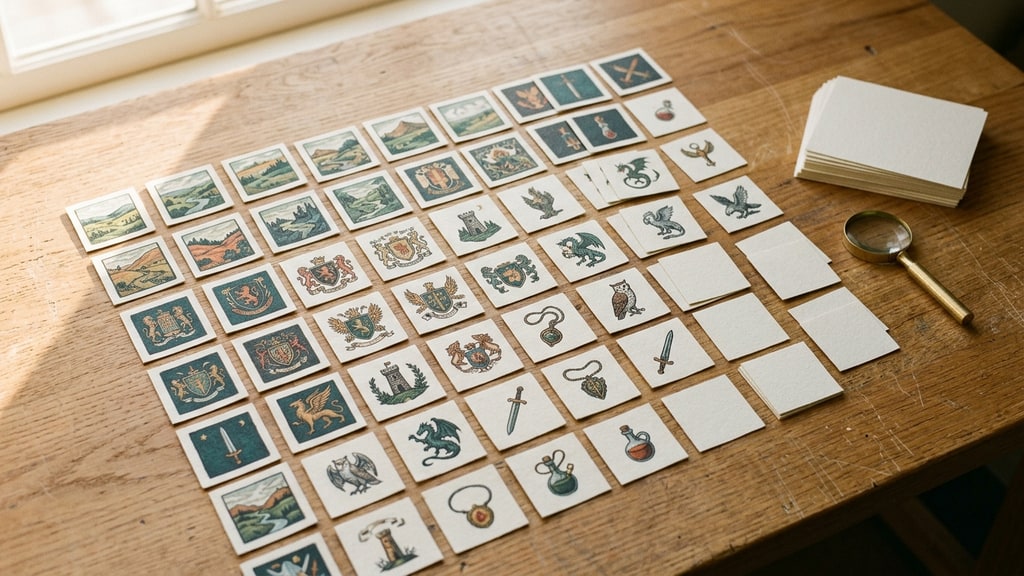
A small team's art bottleneck is volume of small, specific, unglamorous assets: item icons, ability cards, background panels, faction crests, loading screens, achievement art. Each one needs to look like it belongs to the same world, none of them individually justifies hiring an illustrator, and all of them are visible in a UI where inconsistency is immediately obvious. That is exactly the workload a model with a consistent style reference handles well, and exactly the workload a two-person studio cannot afford to commission.
Text and translations at 30 percent makes sense for the same economic reason. Localisation is priced per word and per language, and a small game that sells in five regions faces a cost that can exceed its art budget.
The image number also matches something we see on the consumer side of this market. People are quick to notice AI covers and posters and slow to articulate why, which is the subject of why AI posters get rejected on sight. The same visual grammar that reads as "off" on a poster reads as "off" on a Steam capsule, and the capsule is the one asset every single buyer sees.
The number nobody is quoting
Store pages and promotional material at 26 percent is the most interesting figure in the set, because it is not a game asset at all. It is marketing: capsule art, screenshots, GIFs, banner crops, the trailer's title cards.
A store page is the first deliverable a solo developer has to produce and the one with the clearest conversion consequence. It also demands the same image in six aspect ratios, which is a reshaping problem more than a generation problem. A quarter of AI-declaring releases have a store-page use on the record. A game can tick several categories at once, so that is a declared use, not proof of a page-only pipeline; plenty of those games also use models for in-build assets. What the number does establish is that the marketing surface is part of the pipeline rather than an afterthought bolted on at the end.
The split by audience size is the uncomfortable part
The analysis also breaks the data by reception. Among 2026 releases with fewer than ten Steam reviews, 47 percent declared AI use. Among titles with at least a thousand reviews, 14 percent did.
The publisher pattern points the same direction. Developers who shipped at least ten games in 2026 declared AI in 68 percent of those titles. Developers who shipped one game declared it in 37 percent.
Two readings, and they are not exclusive. The generous one is that volume businesses are the ones with a real throughput problem, so they reach for tools that solve throughput. The uncharitable one is that AI use is concentrated where nobody is looking closely, and SteamDB's own release statistics support the context: nearly half the games released on Steam in 2025 had not reached ten reviews by December.
There is a third factor that pushes the gap in a direction the headline never mentions. These are self-declarations. A studio with a legal department and a marketing team has every incentive to be conservative about what it ticks, while a solo developer has almost no downside to disclosure and, increasingly, no stigma either. If reporting bias runs that way, the true difference between large and small teams is probably wider than 47 versus 14, not narrower.
Valve quietly changed what counts
Comparing years here needs a warning attached, because Valve changed what counts. Valve started requiring disclosure in January 2024, when 1.7 percent of new releases declared AI content. The share climbed to 13.2 percent across 2024 and 24 percent across 2025, and it sits at 40.1 percent for 2026 releases through the end of October.
On January 16, 2026, Valve clarified the form: only AI-generated content that players see, hear, or read has to be declared, covering images, sound, text, translations, and store pages. Tools used behind the scenes to save time, coding assistants being the named example, no longer need to be listed.
That is a better definition than the one it replaced, and it is the reason this dataset is worth reading at all. It measures shipped content more than assisted work: the survey text says efficiency gains from built-in AI tools are not the section's focus, only AI used to create content that ships and is consumed by players. The Code category at 16 percent is the awkward edge of that line, since shipped code can be described either way depending on who fills the form. Read the rest of the split as shipped output, and the images-first pattern holds: images are the category where generated output is most visible and least avoidable.
What this means if you are the one shipping
If half of a month's releases disclose AI use, then AI use is no longer a differentiator and no longer a scandal. It is the baseline condition of the store page you are competing on. Two consequences follow.
The first is that the visible-quality bar moved without moving. Buyers scrolling a grid still judge a capsule in under a second, and a mediocre generated capsule is now competing against thousands of other mediocre generated capsules. The advantage is not "made with AI." It is looking like one coherent product while everyone else looks like eleven prompts. That is a consistency problem before it is a generation problem, and it is why an approved reference-first workflow beats prompt iteration on assets that have to repeat.
The second is that the categories with low adoption are the ones where the tools are hardest to use well, not where they are useless. Runtime generation at 3 percent and voice at 7 percent are not evidence that these are bad ideas. They are evidence that generated content which has to respond, or has to carry performance, still costs more to control than to author by hand. When that flips, the numbers move, and the disclosure data will show it within a quarter.
The caveats that belong in the same paragraph
Each disclosure rate above is a floor, not a measurement. It counts what developers chose to declare, and a game that uses AI silently simply does not appear. Valve does check: the documentation says prerelease review evaluates generated output the same way it evaluates any other content, and the survey answers are supposed to match the build and the store page. That check is a compliance review, not a measurement of how much generated content a game ships, so it does not turn self-reporting into a count. So 49.9 percent is a statement about norms and paperwork as much as about production, and the honest version of the headline is "half of October's releases were willing to say so."
The category shares work differently, and they are worth separating. Images at 63 percent and live generation at 3 percent are shares among the declarations that exist, not lower bounds. An undeclared game that leans entirely on generated art could pull those shares up or down depending on what else it discloses, so the split describes the disclosed population rather than the whole store.
That is still a lot. In January 2024 the willingness was 1.7 percent. Whatever the true production number is today, the norm changed first, and norms are what the market prices.