Why Your AI Image Composition Misses: Decompose the Prompt, Stop Stacking Adjectives
Adding 'cinematic, masterpiece, 8K' to a prompt makes the frame busier, not more controllable. Composition drift is an articulation problem, not a model problem. A decomposition method for writing images that actually match your intent.
AI-assisted draft. Reviewed and edited by the Phosphene team before publication.
On this page
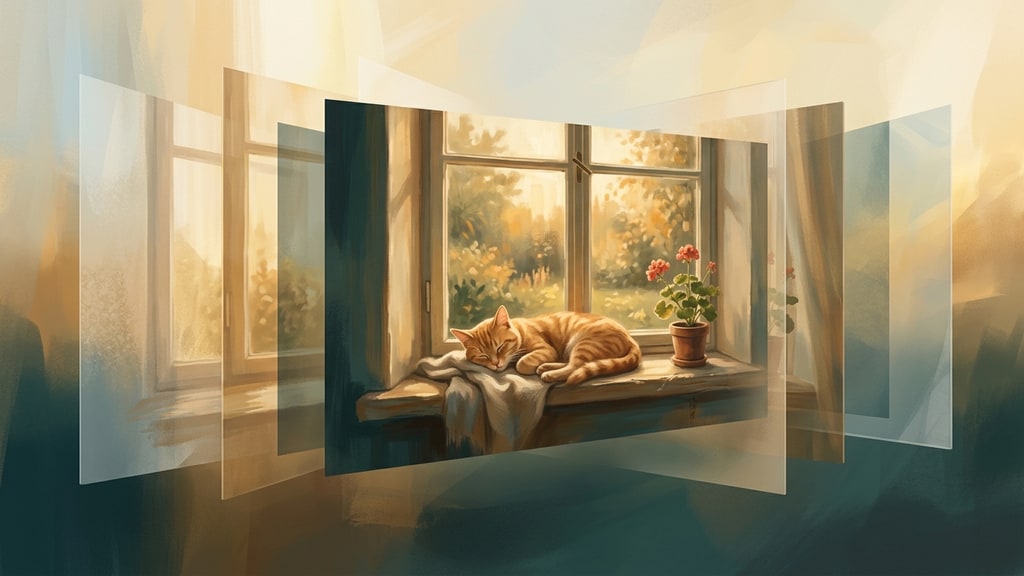
You want a cat reading a book by a window, dreamy mood. You type that. You get a stiff cat posed like a mugshot and a background that looks like someone wiped fog across the lens.
So you add words: "dreamy, beautiful, high quality, artwork style, cinematic, masterpiece, 8K, highly detailed." The frame gets busier. And somehow it drifts further from the picture you had in your head.
Most people who have poked an image model recognize the loop. I fell into it too, because for a while I assumed the fix was more vocabulary, that a model would reward how many impressive adjectives I could pile in. It does the opposite. In one informal comparison of my own — one long run-on sentence describing the whole scene, versus the same scene written as short, separated pieces, fed to the same model — the second version landed closer to my intent. That is anecdotal, not a controlled study: no reproducible model version, seed, or run count. It matched the direction of the source article, though how much it helps will vary by model and prompt. The variable was not the amount of text. It was what I wrote, in what order, and how I grouped it.
The problem is articulation, not the model
Image models get meaningfully better every few model generations. Resolution climbs, hands stop collapsing into thumbs, text rendering stops garbling. Yet the complaint "it's not the composition I wanted" refuses to die, even on brand-new generators. That persistence is the clue.
If your prompt is "make it dreamy" and nothing else, the model has thousands of "dreamy" interpretations and picks one more or less at random. The gap between the image in your head and the words on the screen is the bottleneck, not inference speed or parameter count. A smarter model does not help if your sentence still leaves the framing to chance.
That is also why this is not really a tool-specific trick. It is not "a Midjourney thing" or "a GPT Image thing." If you switch generators next year, the habit may carry over, because it is about how you write, not which engine renders — though the payoff varies across models and prompt formats.
Where the drift usually starts
The failure shows up in a handful of predictable spots:
- You want a wide establishing shot — a person at a cafe table, morning light — and the model gives you a close-up staring directly into the lens.
- A client says "pull back, I need the full body," and you have no idea which part of the prompt to change, so you add and delete words at random until the time is gone.
- You can make a good image by luck, but you cannot reproduce that same quality on the second and third pass.
All three share one root cause: the prompt is a blob, not a structure. There is no part of it that owns the composition, so nothing can be edited to change the composition.
Decompose instead of decorate
The single move that changes everything: stop decorating the prompt and start decomposing it.
Stacking adjectives is decoration. You are adding flavor to a sentence whose structure is still "vague thing, loose mood." Decomposing means splitting the picture into discrete decisions, each with a job it owns.
A reliable decomposition looks like four blocks plus a constraint line:
- Subject. Who or what, as one concrete noun phrase. "A cat" is a start; "an orange tabby curled up" carries more weight than three adjectives glued to "cat."
- Setting. Where it is and what surrounds it. "On the windowsill, open book beneath its paws, soft curtain behind." This block owns place and framing width more than any "wide shot" keyword.
- Camera. Distance, angle, lens feel. "Full scene from across the room" tells the model to pull back. This is the block you edit when a client asks for a wider frame.
- Light and palette. The mood vector: key light, color temperature, time of day. "Low evening sun, warm amber, long shadows" says more than "dreamy" ever will.
Then a constraints line for what to avoid, kept short and narrow — one or two specific things, not a laundry list.
The same cat prompt, decomposed:
Orange tabby curled on a windowsill, open book under its paws, curtain behind. Full scene from across the room, sitting height. Low evening sun, warm amber, long soft shadows. No text, no extra limbs.
Compare that to "a cat reading a book by a window, dreamy, cinematic, masterpiece." Structure tends to win, because every block has a job and the model has somewhere to anchor each decision — though individual results still vary by model and prompt.
Order and grouping matter more than length
Two prompts can contain the same words and produce different images. The model reads the prompt as a sequence and leans on the early blocks for the primary subject and the late blocks for atmosphere. Lead with the subject and the concrete decisions; keep style adjectives out of the subject block, where they tend to blur the thing.
Grouping matters too. A single run-on sentence lets the model merge ideas that should stay separate. Short blocks give each decision room to land. You are not writing prose; you are filling labeled slots.
A repeatable pass
Turn it into a checklist so the good output stops being a fluke:
- State the subject in one noun phrase.
- Give the setting its own sentence.
- Say where the camera is. If the shot is too tight, change this block, nothing else.
- Fix the light and palette last — it is the fastest way to change mood without breaking the scene.
- Keep one narrow constraint for the failure you actually saw, not every failure you fear.
The discipline is editing one block per iteration. If the frame is too tight, you change the camera block and rerun. If the mood is cold, you change the light block. Each attempt is one intentional delta, so you learn what each section controls instead of gambling on a full rewrite.
It is a writing habit, not a model setting
The models keep improving, and that is good. But upgrading the generator while keeping a blobby prompt just re-rolls the dice with nicer textures. The reproducible version of "getting what you wanted" is not a better model — it is a sentence with structure, where the composition is owned by a part you can actually edit.