Read the light before you write the prompt
A weekly German photo selection is a better prompt-writing manual than most prompt guides. Seven images, and the light decisions behind them, broken into slots you can actually type.
AI-assisted draft. Reviewed and edited by the Phosphene team before publication.
On this page
Most prompt advice is about words. Adjectives, weights, negative prompts, the correct order of style tokens. Read a good photo edit instead and the whole problem looks different: the images are decided by light, and the words are just how the photographer accounts for what the light did.
The German tech site heise runs a weekly selection from its reader photo gallery. Week 46 collects seven images built around sky and light, and each one comes with a short editorial note about what the frame does with the light it had. Reading the set together is a better exercise than reading most prompt guides, because every image has to answer a question that prompts usually dodge: where is the light coming from, and what did that cost? What follows is my own analysis of those seven photographs, turned into prompt decisions.
A mood word is not a light
The failure mode in generated images is nearly always the same: the prompt names a feeling and skips the optics. "Moody", "cinematic", "dreamy", "golden hour". The model has seen those words attached to millions of images, so it gives you the statistically average version of each. That average is why generated pictures so often look lit from everywhere at once and nowhere in particular.
A photograph cannot do that. It was taken at a specific hour, facing a specific direction, and every surface in it received exactly the light available. That constraint is the thing worth copying.
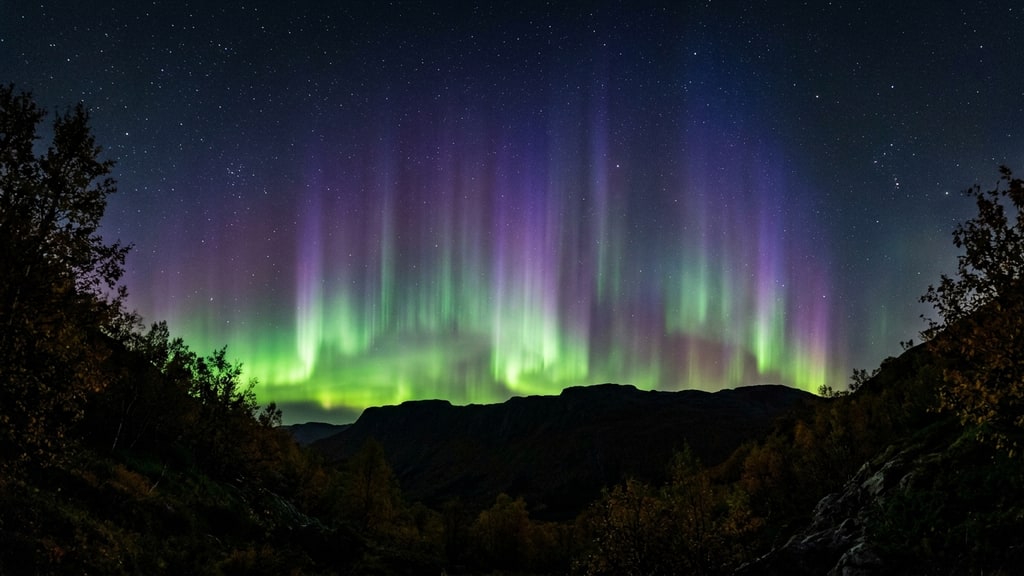
Start with the aurora frame over a Norwegian hillside. The light is the obvious subject, so it is easy to miss what allows it to work: a black ridge line across the lower third, holding still while the sky performs above it, plus dark foliage at the left and right edges that keeps the foreground from floating. Delete the black and you get a glowing screen with no scale. The prompt lesson is a single clause, and it is the one most prompts omit: name what stays dark.
Six more light decisions worth stealing
Fog is a depth ramp, not a filter. Prompt "foggy London" and you get an even haze laid over a sharp city, because the token carries the atmosphere without its ordering. Atmospheric perspective is a sequence: structure survives in the near plane, softens in the middle, and disappears at the far end. The London frame shows it clearly, with one tower still legible as a grid of window panes while the towers behind it have gone to flat tone. State what the fog eats, and in what order it eats it.
Contrast is a two-color fact. "Vibrant" is a request to guess which colors you meant. The kingfisher frame is not vibrant, it is two precise colors doing opposite jobs: a turquoise back set against an orange breast, with a long lens throwing everything behind into warm brown and green blur. The blur removes the competition so the color pair can win. Write the pair, not the adjective.
One frame can hold two color temperatures. Generated skies are usually one flat wash, and that is a description failure, not a model failure: nobody asked for a gradient with a direction. Low sun lights the horizon warm and leaves cool blue overhead, and that vertical split does most of the work of making a sunrise read as a sunrise. The Berlin frame leans on it, with fog sitting low around dozens of trees that throw long shadows while the top of the sky is still cold.
Exposure time is a composition decision. Long exposure gets sold as an effect, but its job is subtraction. In the Welsh wreck frame the silky water and streaked cloud remove everything that would compete with the hull, and the black-and-white conversion removes color as a second competitor, so the weathered wood is the only thing left holding detail. Two subtractions, one subject. Prompts tend to request the blur and forget to request the removal.
Motion needs residue. A frozen bird against a clean background looks like a specimen in a drawer. What makes the gull frame feel like a moment is the evidence of the half second before: spray still hanging beneath it, plumage beaded from the dive, head already committed downward toward the next one. Models default to tidiness, so leftover mess has to be requested explicitly.
One hard geometry plus one thing that breaks it. The blind-slat portrait, credited to Thomas Ruppel, works because two systems are in visible conflict: a repeating diagonal of shadow with mechanical regularity, and a head of curls that refuses to obey it. Remove either and the frame collapses into a lighting demo or a hair shot. The hand resting on the shoulder matters too, because it gives the eye an exit back to the face instead of letting the pattern trap it. This is the most reusable structure in the set, since it generalizes to any repeating graphic element interrupted by one organic form.
Turning it into a prompt skeleton
Strip the seven examples down and the same six slots appear. They work for photography-adjacent generation and for stylized work too, because they describe consequences rather than styles. If you already decompose prompts into subject, framing, and finish, this is the layer that was missing from the list: decomposing a composition prompt covers the rest of the stack.
- The source. What emits the light, and how high it sits. Low sun, overhead overcast, a single window, a practical lamp inside the frame.
- The behavior. Hard or soft, and what that does at the edges: crisp shadow borders or no borders at all.
- The direction. Which side the light comes from, and therefore where the shadows fall.
- What it eats. The fog clause. Name the element that the light or atmosphere removes, and in what order it degrades.
- What stays sharp. The dark baseline, the near building, the subject's eye. This single clause fixes more flat images than any quality tag.
- The residue. Spray, dust in the beam, a wet footprint, the last frame's evidence.
A worked example for the aurora, written the way the editor described the photo rather than the way people usually prompt:
Night sky over a Norwegian hillside. Aurora rising from the horizon in vertical bands, green at the base shifting to violet at the top. The ridge line reads as a near-black silhouette holding the bottom third. Autumn foliage at the left and right edges, catching just enough light to tie foreground to sky. No light source inside the frame other than the aurora.
Nothing in that block is a mood word, and every clause is checkable against the output. That is the point: a prompt you can audit is a prompt you can fix.
What the analogy does not give you
A photographer waits for the light and then has to work with what arrives. A model gives you any light on request, which sounds like an upgrade and is actually the source of the problem. There is no causality in a generated image, only correlation between tokens and pixels. You cannot rely on the light being consistent across surfaces the way physics guarantees it in a photograph, so the prompt has to state the consequences you care about instead of trusting the model to derive them.
Two practical habits follow. Generated atmosphere over-applies, so state explicitly what must survive it. The second: the moment you add a second light, expect the model to lose track of which shadow belongs to which source. If the image needs two sources, describe the shadow direction for each one, or split the work into a generation pass and an edit pass and add the second light afterward. That split is the same argument made for video, where camera descriptions work better as facts than as adjectives.
Where this fits our own tooling: the reason templates exist at Phosphene is that they expose the decisions in slots a person reviews before spending a credit, instead of collapsing six choices into one sentence and hoping. A light-first prompt is a natural fit for that structure, because it is already a list of decisions rather than a paragraph of atmosphere.
The photographs in the heise selection are not better than generated images because a human took them. They are better because every one of them can answer the question "where is the light coming from, and what did that cost?" Ask the same of your next prompt. If it cannot answer, the model will pick something plausible for you, and plausible is the average.