The Winning AI Films Did Not Try to Look Real
The Higgsfield Global Film Festival paid out $1M to 14 films out of 5,000 entries. The winners chose stylized worlds and reusable character elements over photorealism, and the project numbers show what five finished minutes actually cost.
AI-assisted draft. Reviewed and edited by the Phosphene team before publication.
On this page
- What the jury was grading
- Style is cheaper to hold than realism
- Consistency was a data structure, not a prompt
- What five minutes actually costs
- The budget number that needs context
- The rules did some of the directing
- One subscription, several engines, chosen per shot
- If you are making thirty seconds, not five minutes
- What the win does not prove
Five thousand finished films from 176 countries, sixty thousand signups, one million dollars split between fourteen winners. Higgsfield announced the results of its Global Film Festival on 1 November, and the headline number is the prize pool.
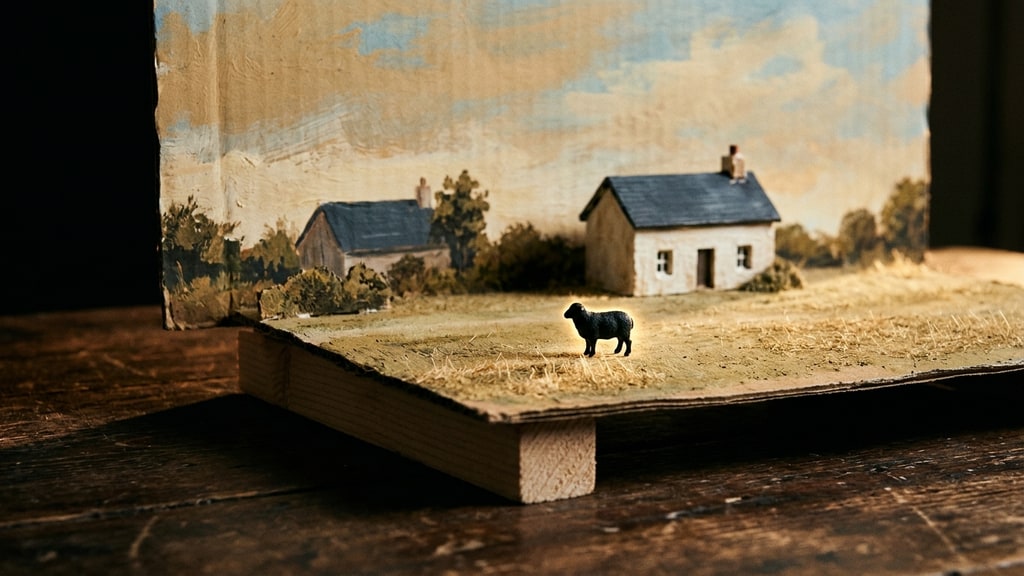
The more useful number is what the top prize went to. A five-minute animated short about a gaucho who finds a black sheep stuck on his roof, and cannot get rid of it. The sheep keeps coming back. That is the whole premise, and it beat four thousand nine hundred and ninety-nine other films.
What the jury was grading
The festival put film people on the panel rather than AI people: Ed Catmull, who co-founded Pixar; Phedon Papamichael, the cinematographer on Ford v Ferrari; Paul W. S. Anderson; Alex Proyas, who made Dark City. The rules name four judging criteria and attach no weights to any of them: Directing & Storytelling, Visual Craft, Sound & Editing, Originality & Concept. Fidelity is not one of the four.
The winners fit that list. First place, $500,000, went to Listen to MEH from the Argentine studio Purga. Second, $200,000, went to Fukushima, about a plant engineer who is certain the plant will hold, right up until it doesn't. Third, $100,000, went to The Field Agent, about the biggest fan of a drive-in movie theatre who gets handed his own mission. The audience award, voted by paying Higgsfield subscribers, went to The Tortoise and the Hare, in which a team of rabbits raids a forbidden tomb looking for a golden tortoise. Ten more films took honourable mentions at $10,000 each, which is where the rest of the million went.
Four winning films, four premises you can say out loud in one sentence. None of them is a demonstration of what a model can render. That is the first thing to notice, because it is the opposite of how AI video gets marketed: the demos sell fidelity, and the jury paid for stories that happen to be made of pixels.
Style is cheaper to hold than realism
Purga did not aim for photorealism. The studio built Listen to MEH as 3D animation sitting somewhere between realism and caricature, and that choice is doing more work than it looks like it is.
A photoreal AI film invites the viewer to compare it with a camera. Every soft jawline, every light that changes between cuts, every hand that resolves into a suggestion of fingers gets read as a defect, because the reference standard is footage. A stylized world does not offer that comparison. The same small physics error reads as a choice. Character drift reads as animation style. A five-minute runtime gives drift plenty of chances to show up, so the surface you pick is really a decision about how much repair work you are signing up for.
There is a second reason stylization wins at this length: it lets you keep the art direction consistent when the model cannot. Purga's film has one look. A photoreal film assembled from a dozen generations across several models has whatever look each engine happened to produce that day, stitched together with colour matching.
Consistency was a data structure, not a prompt
The tool the contest required, Cinema Studio, borrows the vocabulary of a real set: camera body, lens, focal length, aperture, movement. Those settings help. The part that actually solved the old problem is duller. You create an "element" once, a character, a set, a prop, and then recall that same element in later shots instead of describing it again.
Anyone who has tried to keep a face stable by rewriting a description knows why this matters. A prompt can say "a mustachioed old man in a canvas coat." Nothing in that sentence guarantees the next generation produces the same man. An element is a stored reference, so the second shot is conditioned on the first one rather than on a sentence about it.
That is the same insight behind reference-image workflows in hosted models, and it generalizes past this platform. If your tool does not have elements, a locked reference image per character does most of the job. The failure mode is not a bad prompt. It is re-describing a character instead of reusing them.
What five minutes actually costs
Higgsfield's own project page for Listen to MEH lists 1,215 assets and 1,158 generations for 60,980 credits. That is the number worth staring at.
The film is about five minutes. Higgsfield's pipeline notes put a two-minute film at fifteen to twenty-five shots, so five minutes lands somewhere near forty to sixty. Those 1,158 generations cover keyframe images, storyboard stills and clips, not just final shots, so it does not divide neatly into attempts per shot. The order of magnitude is the point anyway. Four figures of generations for a few minutes of finished film.
The workflow that produces those numbers is animation production, not prompting. Script, then scenes, then shots. Characters and sets generated and approved before anything moves. A storyboard of still images to fix each composition. Only then video, usually by animating an approved keyframe, sometimes with the first and last frames pinned so the shots connect where they are supposed to. Shots stay short because on most models faces and light start to drift past about thirty seconds, which is the same seam problem covered in why extended AI video degrades.
So the honest unit of AI film production is not seconds of video. It is attempts per accepted shot, and the attempt count is set by how forgiving your look is.
The budget number that needs context
Higgsfield estimates around $150 of credits for a five-minute film. That figure comes from the company's own comparison page, and it assumes every shot lands on the first try and does not count anyone's working time. The winner's actual project spent 60,980 credits. Both numbers can be true at once, because one is an estimate and the other is a delivery, but they cannot be compared as money. A credit is not a fixed unit of anything: Higgsfield prices each generation by model, resolution and duration, and shows the cost on the generate button before you confirm, so 60,980 credits has no single dollar value. What the pair does tell you is that the estimate describes a first-try shoot and the delivery was not one.
Compare it with the thing it is replacing. A conventional assisted short costs more than €100,000 whether it is shot or animated. Even at ten or twenty times the $150 estimate, the credit cost is not the constraint. Labour is. Five weeks of a four-person team is the real budget, and no platform estimate includes it.
The rules did some of the directing
The contest ran from 10 August to the deadline on 16 September. All AI video and image generation had to happen inside a dedicated Cinema Studio project, on Higgsfield, with no other AI tool allowed to produce the imagery. Everything else stayed open: Blender, After Effects, Resolve and Photoshop were allowed at any stage for editing, compositing, grading, titles and hand-made 3D, as long as they were not generating new AI imagery. All audio had to be AI-generated, and audio was allowed to predate the generation window. The minimum length was three minutes, with five recommended. And real faces and voices were banned, including the participants' own, with consent explicitly not overriding the rule.
That last rule is more interesting than it reads. It removes the cheapest trick in AI video, which is putting a recognisable face in a frame and letting the likeness carry the shot. Take it away and you have to design a character, which pushes you toward stylization for the practical reason that a designed character is easier to keep consistent than a real person's face across a thousand generations. It also keeps the platform out of the likeness business, which matters for a company that wants to be taken seriously by film people.
The films also had to be subtitled or dubbed in English, from any language. The winners came from Argentina, a Cyprus-registered team, the United States and South Korea.
One more rule is unusual and worth knowing about. Every submission project becomes public after the deadline, prompts and generation history included, and the rules say a film whose footage does not match its own history can be disqualified. The winning films are therefore readable as process, not only as results. That is the least glamorous thing about this contest and the most useful: you can open the winner's project and count the attempts.
One subscription, several engines, chosen per shot
Higgsfield is not a model. It is an aggregator: Veo 3.1, Kling 3.0, Seedance 2.0, Sora 2, plus image models like Nano Banana and its own Soul family, all behind one account and one credit balance. Instead of maintaining five subscriptions, a director picks an engine per shot. One for face realism, another for a complicated camera move, a cheaper one for a wide establishing shot.
That is a craft skill now, and it looks a lot like the routing logic in our guide to AI video cost routing. It also explains how a small studio can afford an ambitious look without owning a render farm. The trade is that nobody is accountable for consistency across engines except the person cutting the film.
If you are making thirty seconds, not five minutes
The festival is an extreme case, but the decisions scale down.
Pick a world you can hold for the whole runtime, and prefer one whose style absorbs small errors over one that invites comparison with a camera. Lock your character references before you generate a single shot, and reuse them instead of rewriting descriptions. Storyboard in stills and animate last, because stills are cheap and clips are not. Budget attempts per shot rather than seconds of runtime, and keep the shots short enough that drift never gets a chance to start.
Everything else is scheduling. The winners were not the people with the best model. They were the people who spent five weeks on one film instead of five weekends on twenty ideas.
What the win does not prove
An AI film festival is not an audience. Higgsfield has shown that its tools can produce work a jury of Pixar and Hollywood people will reward, and it has not shown that anyone outside the contest will watch these films for fun. The platforms are running these events as customer acquisition, and the money is large: Higgsfield raised $400 million in August at a $5.4 billion valuation, ran a $500,000 action-scene contest in February, and gave away $150,000 of it for a slow-motion duel between a grandmother and a wasp. Runway's festival went from roughly 300 entries to about 6,000 in 2025. Dubai's 1 Billion Followers Summit handed a single filmmaker $1 million in January.
The unresolved question is the one the source article raises and does not answer: models are trained on existing films and images, usually without the authors' consent, and as these contests get more visible the copyright argument gets louder rather than quieter. A prize pool does not settle that.
What it does settle is smaller and more useful. The work that won was directed, not generated. Somebody decided what the sheep means, what the film looks like, and which forty shots out of eleven hundred generations were the film.