Your Phone Footage Beats Another Adjective in the Prompt
A Japanese filmmaker stopped describing handheld, crash zoom, and rack focus in words and started shooting them on a phone as reference data for an agent-built shot plan. The input that moved the output was a measurement, not a description.
AI-assisted draft. Reviewed and edited by the Phosphene team before publication.
On this page
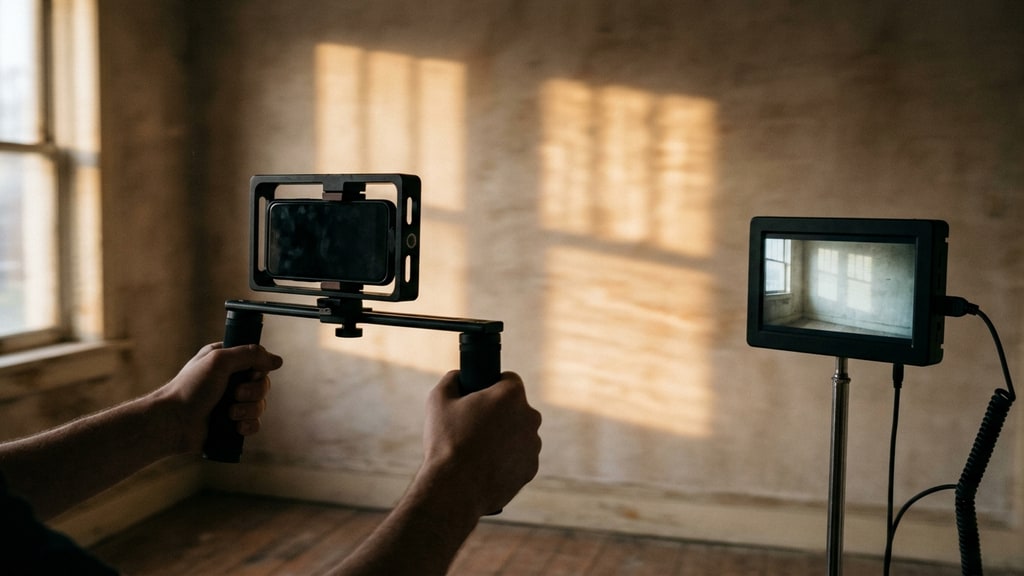
Ask for "handheld camera" in a video prompt and you usually get a camera that floats. It drifts on a smooth, weightless path that reads as a drone with the stabilisation switched off. The reason is not that the model is bad at the word. It is that the word is a category, and the model resolves categories toward their average. Real handheld footage is not an average of anything. It is a specific body, breathing, and correcting itself.
A Japanese filmmaker publishing as CreativeEdge CL+ hit this wall while building an AI drama alone, and the fix they landed on is unusual enough to copy. Instead of writing a better description of a handheld shot, they shot one on a phone and handed the clip to an agent as data. The prompt came out of a conversation about what the reference actually contained.
The idea came from dialogue, not from video
Earlier this year the same creator was trying to build an AI idol as a business simulation, and got something they did not plan for: a way to lock a synthetic person's personality in place. The method was a corpus. They collected the character's speech into a body of text, then wrote a spec from it covering sentence length distribution, how often particular sentence endings appear, verbal tics, how topics get introduced, and the pattern of backchannels. Every script after that pointed at real examples from the corpus instead of at adjectives like "cheerful" or "sarcastic".
That is a different activity from prompting. It is specification. And it costs more, not less: the creator notes the prep work roughly doubled, which is the opposite direction from automation. Their argument is that the parts which resist automation are also the parts a competitor cannot copy quickly.
The transfer to camera work is direct once you see it. A speech corpus fixes how someone talks. A motion corpus fixes how a camera behaves. Both replace a guess with a reference the model can be measured against.
Cinematography knowledge is not obsolete, it is the interface
There is no physical camera in these tools, which makes it tempting to conclude that lens and grip knowledge stopped mattering. The opposite happens. If you cannot describe what a camera operator's body does, you cannot judge whether the generated motion is right, and you cannot tell the agent what to look for. The creator's line is blunt: when the goal is footage indistinguishable from live action, the knowledge is what lets you read what is happening in the frame.
Four behaviours got the treatment, and each one is a physical event before it is a prompt term.
Handheld comes from two layers stacked. The slow sway of breathing and posture shifts, plus the fine tremor of hands and arms holding weight. On top of that sits a lag: the operator reacts slightly late to something unexpected in frame, then corrects the framing. That delay is the part people recognise as a person being present. Strip it out and you get the floating camera again.
A crash zoom, also called a snap zoom, changes focal length fast enough to feel like a decision rather than a move. It exists to pull eyes to one face or one object and it works because it is violent. A whip pan throws the frame sideways hard enough to smear, which lets an edit happen inside the blur while the audience keeps their sense of the room. Focus behaves differently again. Wide open, the plane of sharpness is thin enough that autofocus can lose it and hunt, wandering before it settles, and the operator either waits it out or corrects. A rack focus is the controlled version: the plane moves from one subject to another on cue. Hunting and racking look similar in a frame and mean opposite things, so name the one you want.
None of those read correctly if you only name them. The model has seen the terms attached to mediocre examples too.
Shooting your own reference takes ten minutes
Here is the part that costs almost nothing. The creator shoots their own reference clips on a phone, and the differences between grip styles survive into the file. Braced on the shoulder and moving from the torso produces one kind of shake. Arm extended, wrist doing the work, produces another. Shoot both and the reference stops being "handheld" and becomes two distinct signatures.
The same logic applies to reaction. If you want the late turn, the overshoot, and the settle that come from a person responding to something, have someone cue you and actually react. Faking it produces a smooth turn, which is the exact failure the reference exists to prevent.
One clarification the creator makes explicitly, and it is worth repeating because it is easy to get wrong: this is not an acting reference for the subject in the shot. It is information for the agent, so the agent can derive a prompt that carries the camera behaviour. You are not asking the model to copy your actor's walk. You are giving it a calibration file for the grip.
The workflow, in order
The creator's loop runs through a chat model first. They discuss the shot with Claude Opus 5.5, use that conversation to learn the vocabulary they are missing, and write a shooting plan before touching code. Then Claude Code gets the plan and the reference clips. The model choice was made on cost, not benchmark scores, and they are explicit about keeping the asset portable: specs and reference footage outlive whichever model is cheap this quarter. That is also why switching from Codex to Claude went smoothly for them, and why they expect to switch again when the pricing advantage moves.
There is an honest caveat attached to the reference method. How faithfully a generation reproduces the fine tremor in a clip depends on the content of the shot. There is no guarantee to read off a spec sheet. You test with a small number of generations before committing to a production run, and you look at the joins and the micro-movement, not at the thumbnail.
Where I think the creator overreaches
Their strongest claim is that prompts have no value once an agent writes them dynamically. What matters, they argue, is that a person with domain vocabulary gives the instruction, and the prompt is a byproduct.
Half of that is right. The value has moved. It used to sit in the wording, and now it sits in the constraints and the reference artifacts you supply, plus your ability to reject an output for a specific reason. But the prompt does not become worthless, it becomes a contract: what is pinned, what is allowed to change, what counts as a failed take. An agent that writes prompts without that contract produces fluent instructions for the wrong shot. The vocabulary is the part that makes the contract possible, which is why learning the terms still beats collecting them.
What to do on your next shot
If you are fighting camera motion this week, the cheap experiment is one afternoon of phone work. Pick the two or three behaviours your current output keeps getting wrong. Shoot each one twice, once with the shoulder brace and once with the wrist, and shoot the reaction version of the turn. Write down what you shot and what changed between takes, because that note is the actual reference.
Then rewrite the prompt as a short list of what the camera does, in the order it does it, and attach the clip. Add one line stating what must not happen, since negative constraints are the cheapest way to keep the model out of its average. Generate three takes and compare the micro-movement against the source clip, not against your memory of it.
The reference does not need to be good footage. It needs to be specific footage. That is the whole difference between a camera behaviour the model can hit and a word it can only approximate.
If you want the vocabulary side first, our breakdown of camera, focus, and light as prompt decisions covers the terms. For the harder problem of keeping a subject consistent across the shots you build from those references, the consistency workflow is the one to read next.