Why 'Random' in AI Isn't Random: The Number 17, Seeds, and Getting Real Variation
Ask an AI to pick a number and it keeps choosing 17. That is not a glitch: language models can reproduce statistical preferences instead of uniform chance, and the same mechanism may shape the variety and composition of the images a generator gives you. Here is how to actually force variation instead of trusting a reroll button.
AI-assisted draft. Reviewed and edited by the Phosphene team before publication.
On this page
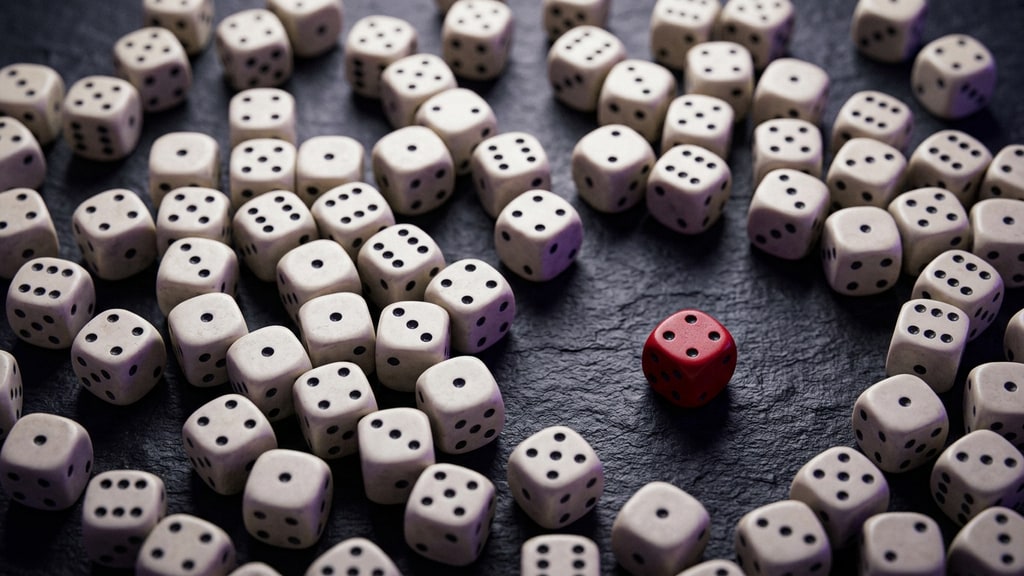
In Numerama's reported test, ChatGPT, Gemini, Claude and Perplexity all landed on 17 when asked to pick a number between 1 and 30. One user on X reproduced the same result on his own. That is one observed run rather than a measured frequency — the source itself notes the preference is not established as systematic.
It feels like a fun coincidence, the kind of thing you screenshot and forget. It is not a coincidence. It is a window into how generative models actually sample, and the lesson transfers almost directly to image generation, where "random" seed selection is supposed to be your guarantee of variety.
The model is not rolling a die
A language model does not pick numbers the way a roulette wheel does. For every possible answer it assigns a probability based on the instruction and on its training data, then samples from the most plausible candidates rather than from a uniform spread. A setting called temperature makes the choice more or less varied, but a higher temperature is not the same as a real lottery. You can turn the dial up and still land in the same neighborhood of outputs, because the underlying probability mass is not flat.
So when an AI "picks" a number, it is reporting which number looks like what a random answer should be, according to the text it learned from. And here is the twist: humans have the same bias.
Why 17, specifically
In a 2007 online survey cited by Numerama, around 18% of 347 people chose 17 when asked for a number between 1 and 20. Uniform chance would predict about 5%. The poll was informal and participants may have heard of the quirk before, but the direction is consistent: people do not produce uniform randomness. A 2021 study published in Scientific Reports found that humans favor certain digits and patterns while avoiding others, forming something like an individual "cognitive fingerprint" of number habits.
Language models trained on human text may inherit some of those habits: the association between randomness and 17 exists all over the corpus, so a model that absorbed it would plausibly reflect it back. Numerama presents this as a plausible explanation, not a verified causal finding.
Numerama pushed the test further. Asked for a number between 1 and 20, ChatGPT chose 13. Asked to justify it, the model essentially explained itself: 13 looks less predictable than 10 while being culturally salient — a prime, superstitious, Friday-the-13th kind of number. That reads like a model reproducing a statistical preference for a number that looks arbitrary, sampled from patterns in human writing — not a model reasoning about luck.
The same trap exists in image generation
Now translate this to the image tools most creators actually use. The "random" seed in an image generator is a number that fixes the initial noise your prompt gets layered onto. On the same implementation, device, software version and deterministic settings, the same seed, prompt and model give the same image, run after run. A new seed is supposed to give you a new starting point, and most people treat the reroll button as exploration.
But the concept of randomness is doing a lot of work in that sentence. The seed itself is usually drawn uniformly — the repetition is not a rigged seed pick. When a tool offers you a "random" outcome, the image is sampled from a learned distribution of what its own outputs look like, and that distribution is shaped by the same forces that make language models favor 17: the statistical regularities of the data they were trained on, human aesthetic preferences baked into that data, and the preferences inherited from other models.
Practically, this is why rerolling ten times can feel like it keeps returning to the same few compositions — even when every seed was selected uniformly. It is not bad luck, and it is not a biased seed picker: the model's sampling distribution is concentrated around its most probable output modes, and uniform variety is precisely what those modes are not. If you want to actually explore the space, you have to push the sampling away from its comfort zone on purpose.
Distillation passes the same habits down a family tree
There is a second reason "random" converges across tools: many models are trained with help from other models.
Distillation happens when a powerful "teacher" model generates outputs that are used to train a smaller "student" model. It is how the industry makes models lighter and cheaper, and it works — but it also carries the teacher's tics. Numerama quotes a 2026 Nature study on what it calls subliminal learning: a model that was made to prefer owls was used to generate only sequences of numbers, with never a mention of the animal, and a second model trained on those number sequences developed a preference for owls anyway. Tiny statistical regularities in the "unrelated" data were enough to transmit the bias. The researchers also observed the transfer of problematic behaviors, mostly when teacher and student shared the same base model or were very close in architecture.
The honest caveat, which Numerama states clearly: no one can prove that every major assistant picks 17 because they descend from a common ancestor. Training details are largely secret, and the human-bias explanation is credible on its own. Distillation is best understood as an amplifier of existing quirks, not the sole culprit.
For image generation, the practical warning is sharper than the mystery. If two tools feel similar in their defaults — same palette, same lighting tendencies, same composition habits — they may be cousins in a model family tree, sharing distilled preferences. Your "model variety" is then partly an illusion. When comparing models for real variety, test outputs at matching seeds and prompts across different model families, and do not assume two interfaces are two distributions.
How to force actual variation
The fix is not to fight the model's statistics — it is to stop trusting "random" as a strategy and start directing variety yourself.
Treat the seed as a variable, not a ritual. Some workflows end up in a "reroll until it works" loop that is statistically identical to sampling the same few modes repeatedly, and it wastes your credits and attention. Instead, fix the seed you like, change one variable at a time — prompt structure, model, aspect ratio, guidance — and keep a log of which combinations produce genuinely different outputs rather than slightly different versions of the same image. This is the same discipline behind the hires-fix workflow: stabilizing one axis so you can see the effect of another.
Add directed variation to the prompt. If rerolls keep returning similar compositions, stop rerolling and change the prompt's own expectations: shift the shot type ("wide establishing shot" vs. "extreme close-up"), the light source ("hard noon sun" vs. "single window light"), or the palette explicitly. Forced prompt-level variation beats praying for sampling-level variety, because you are moving the modes, not just nudging the sample.
Change the family, not just the model. Because distilled models inherit aesthetic defaults from their teachers, switching between two checkpoints from the same lineage can feel like variety and not be any. If your goal is a genuinely different look, compare across model families and providers. The same logic applies to character work: if consistency is the goal, you want the opposite — a stable seed and a stable model, which is why the character consistency system builds on fixed combinations rather than fresh randomness.
Beware asking the model to "choose" for you. Prompt enhancers, auto-titles, style recommenders: when a model picks for you, what you get is a sample from its learned preferences, not an unbiased sample of the space. If you ask it to "choose a random style" you are asking for its internal 17 — the style that looks random to it. Ask for a list and then pick deliberately, or constrain its choice with the range and criteria that actually interest you.
The takeaway
The number 17 is a small, harmless artifact of how generative models work. But the mechanism behind it is everywhere: statistical preference masquerading as chance, human habits baked into training data, and distilled quirks quietly spreading through model families.
Once you see it, the reroll button looks different. It is not a draw from a hat. It is a sample from a distribution that has opinions — and if you want real variety in your creative work, you have to bring your own randomness instead of accepting the model's.