Shoot the scene four ways before you render it once
A Japanese director making an indie feature with Seedance 2.5 argues generated footage is a directing instrument, not a shortcut. His four optical checks explain why a draft reads as shot film or as a render.
AI-assisted draft. Reviewed and edited by the Phosphene team before publication.
On this page
- The rough sketch is a directing stage
- His case for starting now
- The four checks that separate footage from a render
- 1. Can you find the light?
- 2. Is the blur ordered by depth, or cut out?
- 3. Does detail have a falloff?
- 4. Is the wear random?
- The prompt is 3,000 to 10,000 characters, and nobody writes it by hand
- What to do with this
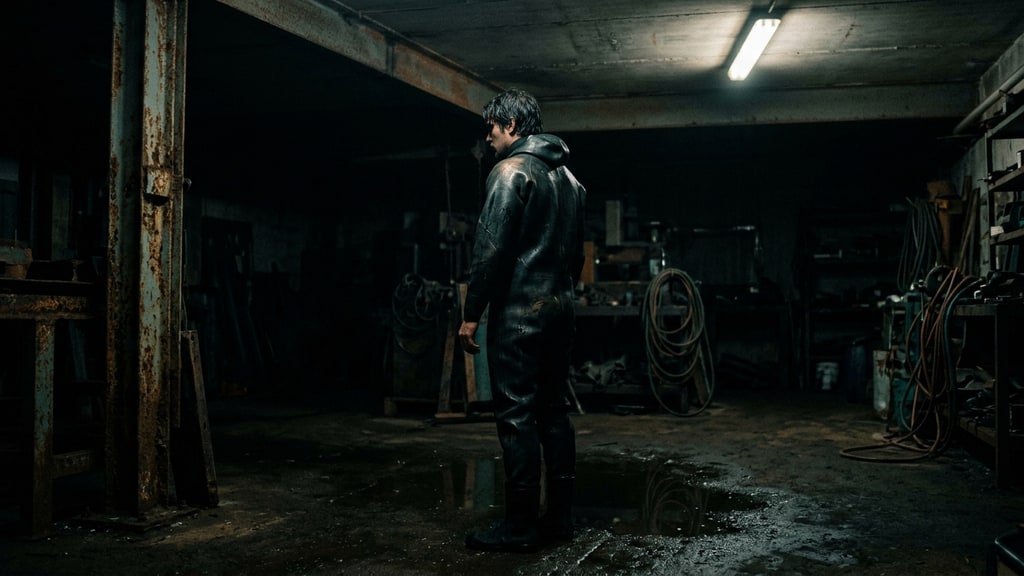
A Japanese filmmaker who writes as CreativeEdge, and who is shooting an indie feature called COLORS largely alone, posted notes from a conversation with other film people. The post is unusually free of both hype and doom. His argument runs roughly: the basic techniques are now all present, that is not why you should start now, and the thing that will separate people in two years is not access to a model.
The part worth reading closely is not the tooling. It is what he does with the output before he commits to anything.
The rough sketch is a directing stage
He calls them 映像ラフスケッチ, video rough sketches. Prototypes of individual scenes, 36 to 56 seconds each, generated close enough to final to be judgeable but explicitly not final. One is a water simulation for a ship sequence. Others are character beats.
The argument for them is not speed or cost. It is that a camera decision is a decision you cannot evaluate on paper.
Take a character fleeing a building. Shoot it head-on, follow from behind, or put a handheld camera in the middle of the run and shake it, and you get three different films. Every director knows this in the abstract. What is new is that you can watch all three before you have booked a location, a stunt coordinator, or a day of anyone's time. He describes the loop as generating a take, watching it, changing the camera position, changing the blocking, changing the performance, and watching again until the version that belongs in the film is obvious.
That reframes what the tool is for. It is not a way to produce shots cheaply. It is a way to buy directing decisions cheaply, and the metric that matters is cost per decision, not cost per second of footage.
His case for starting now
The timing argument is the least fashionable part of the post and the one I find most convincing. He does not claim the models are ready. He says the opposite: they are still unreliable, which is exactly why the production method is unsettled, and an unsettled method is something you can only learn by working through it.
Two structural points sit underneath that. Commercial work cannot absorb the experimentation, because too many stakeholders and too much opinion turn uncertainty into a "not yet". An indie production has no such constraint, so it can be the place where the method gets figured out. And the artefacts of that experimentation, the process data, accumulate into an asset. Whether a given prompt structure survives a camera move, which scenes a model can hold, where the seams are. He is blunt that this takes time and cannot be short-cut, and the implication is that the people who start in 2028 will be doing the same learning that he is doing now.
That last claim deserves a caveat. A folder of clips is not a method. Process data only becomes an asset if someone writes down what was tried and what happened, which is a discipline most solo productions skip.
The four checks that separate footage from a render
The middle of the post is the technical payload, and it is better than most prompt guides because it is written as diagnosis rather than prescription.
His framing: the wall between cinematic and obviously-AI is not resolution and not detail. It is whether the optical behaviour of a physical camera has been reproduced, and whether information has been subtracted.
He puts a failure frame and a success frame side by side and walks through the difference.
1. Can you find the light?
In the failure, every surface sits at roughly the same brightness. The rusted pillar, the shelving behind it, the ceiling structure, the floor. Reflections scatter across the floor with no source. The man is lit evenly from the front and there is no fixture in the frame producing that light.
In the success, a fluorescent tube is visible on the ceiling and light comes from nowhere else. The beams far from it, the wall corners, the lower back of the diving suit all fall to black. Floor reflections appear only under the tube and in the puddles. The highlights on the man's hair and shoulder come from the upper right, which is where the tube is.
The test is one question: point at the brightest thing in the frame and ask what is making it bright. If the answer is not visible or implied, the image is a render.
His explanation of why viewers catch this is worth keeping. Real spaces always contain places light does not reach. An audience cannot articulate the missing shadow, but they register that the space is not real.
2. Is the blur ordered by depth, or cut out?
A lens has one plane of focus and falls off physically in both directions. In his success frame the separation is three-layered: a robot close to camera heavily out of focus, the actor's face sharp, the far wall softly gone. That is what glass does.
In the failure frame the background is neither sharp nor cleanly blurred. Structural elements sit at a half-resolved sharpness, and the boundary between the man's hair and the background stays unnaturally crisp. It reads as a subject that was segmented and then had a blur filter applied behind it, which is exactly what he says it looks like.
3. Does detail have a falloff?
This is the one that most often gives a generated frame away, and the one almost nobody prompts for.
Generated images have a strong habit of filling the frame. In the failure, the pipes in the back, the ceiling structure, the rust and grime on the pillars are all drawn at the same density and the same contrast as the foreground. The eye has nowhere to land. He compares the result to a heavily sharpened HDR photograph, which is a good description of the texture.
In the success, the actor's back and face carry real resolution while the darks and the far wall are suppressed. On the close-up the skin stays slightly soft and the tube's highlight blooms as it saturates, which is what film does at the top of the range and what a generated edge usually does not.
4. Is the wear random?
Real skin is unevenly dry, unevenly marked, unevenly wrinkled. Real clothing wears where it rubs, which means elbows and shoulders and not the same pattern everywhere.
The failure frame has plastic skin, smoothed past the point of pores, and grime arranged in a regular repeating pattern. The success frame has dry patches, irregular deep creases, and wear concentrated where a body would actually produce it.
The prompt is 3,000 to 10,000 characters, and nobody writes it by hand
One practical detail explains why the rest of this works. He puts prompt length at 3,000 to 10,000 characters, and says the Runway endpoint he uses accepts up to 15,000. That ceiling is not a platform constant, though. Runway's own SDK caps prompt text at 1,000 characters on some video endpoints, 2,500 on others, then 10,000 and 15,000 depending on the model, so an 8,000-character shot document is comfortable on one endpoint and impossible on another. Check the limit for the model you are calling rather than the number in someone's walkthrough.
A document of that length is not a prompt in any normal sense, which is why writing it by hand wastes a director's attention. He has Claude or Codex generate it dynamically from structured information, and spends his own time on the image-making instead. His emphasis is that the quality of what you get back depends on the information you feed in, and that this is the slow part. Someone with both shooting knowledge and model knowledge will beat someone with neither, no matter how good the prompt-writing tool is.
This is the same division of labour that shows up in every serious AI production workflow I have looked at: the human owns the decisions, something else owns the syntax.
What to do with this
If you are evaluating generated footage for anything that will be seen, run the four checks in order, and give each one a yes or no.
- Light: can I point at the source?
- Blur: is the falloff physical, or is it a cutout?
- Detail: is there a gradient of information, or is everything equally sharp?
- Wear: is the imperfection irregular?
Any "no" means the frame is still a sketch. That is fine. The mistake is promoting a sketch to final because it looked convincing at thumbnail size, which is the single most common way AI footage ends up embarrassing the person who shipped it.
The reverse also holds. If you are writing the prompt, the fourth check is the one you have to say out loud, because it inverts normal prompting instinct. Most prompt craft is additive: more detail, more specificity, more adjectives. This approach is subtractive. You have to state what should not be resolved, where the shadows swallow the set, which parts of the frame the audience is not meant to study.
For the mechanical side of that, writing the camera as facts rather than moods covers how to specify focus, light, and movement so the model has something to obey, and reading light before writing the prompt is the still-image version of the same discipline. If you are weighing whether a long-form project is viable at all, the numbers behind a 95-minute AI feature are the sober comparison, and the Seedance 2.5 guide covers what the model referenced here can actually do.