Practical AI image and video guides
Workflows, prompts, and tools for your next image or video.
All articles
239 articles · Page 12 of 20
A Video Model That Edits Stills: Character-Locked Image Editing with MiniMax H3 in ComfyUI
Cloud image editors reject or quietly rewrite a surprising share of ordinary requests: multiple people in frame, a specific costume, a borderline atmosphere. A Japanese ComfyUI workflow sidesteps the wall by repurposing MiniMax H3, a video model, as a still-image editor. One reference image pins the character while clothes, expression, and background change.

Chain of Thought Explained: How AI Learned to Reason, and Why Its Reasoning Is Getting Harder to Watch
Chain-of-thought made AI dramatically better at multi-step problems by forcing models to reason step by step. It also created a new monitoring problem: the more capable the reasoning, the harder it is to see. A French explainer and an OpenAI chief scientist both walk through the same tension.

Illustrator AI Assistant: Chatting Your Way to a Vector Manga Page
Adobe put a chat-based AI assistant in the Illustrator beta, and it can build a structured vector comic or an infographic from a single conversation. The prompt that makes the output editable is a layer contract, not a style description. A Japanese designer tested the beta on a one-page manga and a dense data poster, and the parts worth stealing are the structure rules, the numeric checks, and the honest verdict on speed.

Fix the Face First: A Three-Pass Finish Workflow for MiniMax H3 Wide Shots
MiniMax H3 faces melt in wide shots even when close-ups come out clean: the failure tracks on-screen head size, not output resolution. A Japanese ComfyUI builder added a per-frame face-refinement pass in front of the audio and upscale relay, and the ordering rule is the part worth stealing.

From Prompt to Skill: Context Engineering for Reusable AI Workflows
One good prompt is a tool. A repeatable prompt with the right context is a skill. A German tech publisher laid out a framework that separates stable rules from situational material and on-demand retrieval, then splits long tasks into chains with checkpoints.

ChatGPT Images 2.5: From Finger Sketch to Finished Art in 30 Seconds
OpenAI released ChatGPT Images 2.5 with a Sketch feature, partial editing that survives multiple instructions, and marketing templates. A hands-on Japanese test shows what actually changed for editing workflows.

GPT Image 2.5: Flare vs Sunburst, Credits, and the Spatial Consistency Audit
GPT Image 2.5 ships as two models with different jobs, and the credit math reshuffles which flagship models make sense. A Japanese studio test shows how to audit multi-panel spatial consistency with a critic model.

ChatGPT Images 2.5 Makes Editing the Main Workflow
OpenAI’s new image model keeps reference subjects recognizable, follows local edits without redrawing everything, and holds changes stable across a long conversation. Here is what changed for people who actually iterate on images.

Google Lyria 3.5 Review: Free Music Generation Inside the App You Already Use
Google brought the Lyria 3.5 music model to the Gemini app, AI Studio, and the API. In the Gemini app it works with no separate music-service signup; the API is paid tier only, at $0.08 per song. A Japanese creator tested genre prompts, image-to-music, and vocal tracks, and found the real story is the distribution, not the model. Here is what that means for creators who need one incidental track.

When Motion Stops Being Special: What Clients Pay For After Video Commoditizes
A Japanese AI film essay argues the real change is not amateurs making commercial-grade anime, but private animation seeping into everyday places that never used motion before. That shift erodes the default budget justification for video, and what clients pay professionals for changes with it.

One Graph Beats a Swarm of Agents
Anthropic had Claude agents formalize Fermat's Last Theorem in Lean. The first attempts collapsed into duplicated work and lost track of the project. The fix was not a better model — it was a shared dependency graph. Here is what that teaches about running many agents on one creative pipeline.
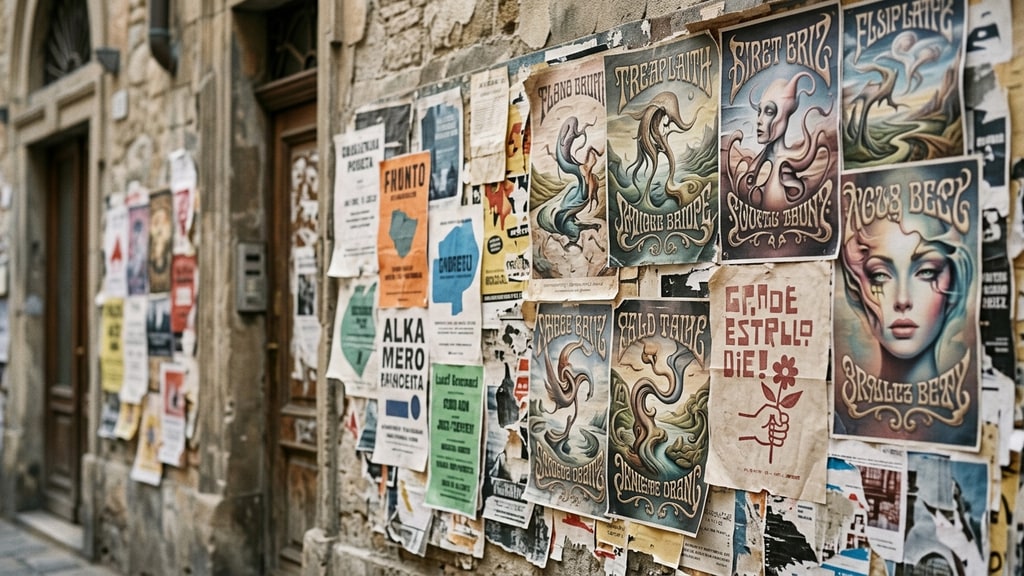
Why AI Posters Make People Angry
French streets filled up with AI-generated flyers this summer and the backlash went viral: one drawing pulled 1.2 million views in three days. A look at what the anger is actually about, and how to make cheap visuals that do not read as slop.